7.20.2009

Windows of the Future!

Despite saying to people for a long time that my thesis was about 'cyborgs', I realize that this is not entirely the case. Speaking about cyborgs gives me an easy way to reference the politically engaged writing of Donna Haraway which has contributed greatly to the lens through which I am composing this thesis. So that's one reason I've been talking about it as a cyborg thesis. Also, talking about cyborgs sounds good. And it's also a little bit funny to say you're studying cyborgs ... to me anyways.
The text component of my thesis (when it's written!) will indeed engage with cybernetic organisms both as depicted in fiction and as they are emerging in reality (or should I maybe say we?). Although I am considering diagramming what the 'cyborg subject of the future' might look like as one aspect of the thesis, the design components will not deal with the cyborg subject, per se, at all (by which I am referring to the typically imagined, Terminator-style cyborg).
If, however, we consider all apparatae to be extensions of the human body, and the house to be an apparatus, then the infusion of cybernetics into this 'second skin' does constitute an example of our cyborg-becoming. At any rate, that is what I have chosen to concern myself with. Rather than dealing directly and solely with how the senses of space and place so central to who we are are changing as we incorporate technology into our bodies, I am looking at designing instances in which the architecture itself becomes 'plugged-in'. For example, rather than imagining and describing how we could wear a portable computer which gives us direct retinal access to every document ever published, I am more interested in investigating how we could use a coffee table to interact with that same database. This interest is predicated on two observations: 1st, that our current manner of interacting with computation and information is impoverished and unfortunately biased towards the visual, the most disembodying of the senses; and 2nd that, as Hiroshi Ishii has said, quoted by James Geary, "to actually physically feel something enriches our perception of it and allows us to interact with the environment as we were meant to." By distributing computing throughout the entire house we are no longer 'fixed' to the computer, allowing us to use both our mind and our body simultaneously in navigating a layered world of bits and atoms.
Below, I imagine a window:
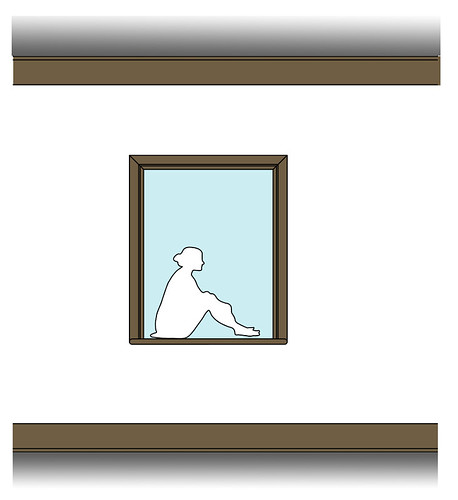
As a means of setting up the experiment, here is a 'regular' window
Freed of the traditional structural constraints of lumber or of masonry (for instance by using structural insulated panels or some other distributed structural system) the window could be any shape. What shape should it be? Here, being a window seat, it is intended to fit the human body on the one side, and allow the 'user' to interact with information on the other side. It's also, I noticed, the shape of a 'D'.
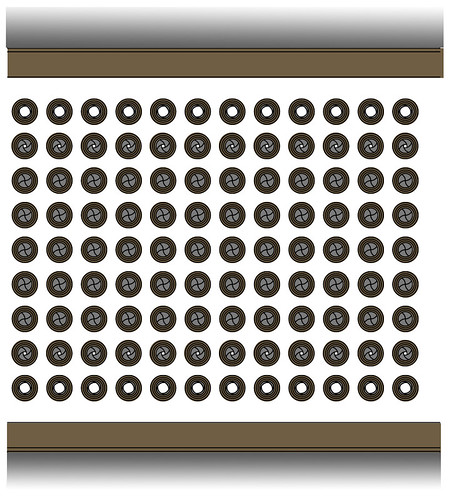
Alternately, the functions of the window (light, communication, ventilation, etc) could be miniaturized and distributed. Above I have attempted to miniaturize and distribute the ventilation function of the window. Ventilation could be controlled very accurately this way, for particular tasks. I have a sketch that shows how this would work on the scale of the house that I will post soon.
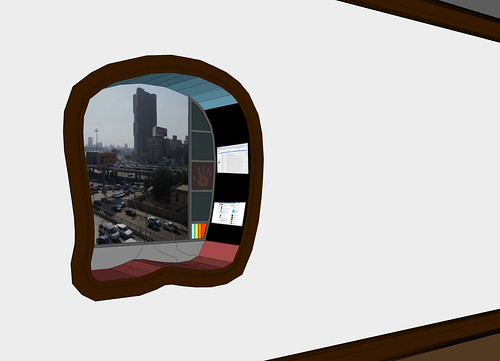
Here is the window seat in perspective. On the one side and on the bottom the unit is lined with foam, while on the other side and the top are two curved lcd screens. The screen opposite the 'user' is to give them access to things like social networking, weather, etc: augmentations of the traditional uses for a window.
The panel to the right of the glass gives access to various functions. The large black pieces are scroll-surfaces which the 'user' can use by brushing their hand against it: brushing one of them up opens the window; brushing it back down closes the window. The other two black surfaces are for controlling the opacity of the window and the density of the screen. Liquid crystal layered into the glass allows for information to be layered over the world outside. The buttons along the bottom control what information is being displayed - in the image above the weather forecast is being displayed. The reddish panel to the right is a temperature simulator, also for the forecast of weather.
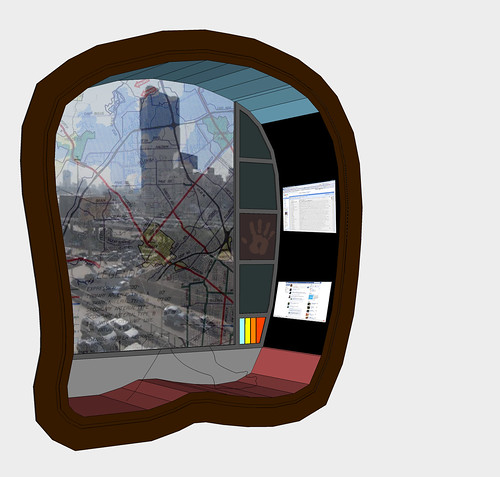
Above: traffic conditions for local neighbourhood displayed on the window

As I have described elsewhere, architecture can be described as the engineering of boundaries between scales of ecological networks. This is fancy-talk for the fact that architecture locates or 'places' us in relation to systems of distribution and production, literal ecological networks (shedding rainwater, keeping the bugs out, growing a garden), and informational networks (a phone number or an ip address for instance). Windows are about permeable, controllable boundaries. Window seats are all about inhabiting these boundaries and this window seat is about inhabiting several boundaries at once.

7.19.2009

Beds for Cyborgs, Beds for Hermits

The following are a couple of fanciful bed designs that I developed recently. They are very roughly rendered I am afraid, but I hope get the ideas across. They are very different sorts of designs, one very permanent, the other miniaturized and portable. If you want to see them you should definitely click on the image or else they will be too small!


7.18.2009

Images From Harvard Medical Guide

Here's a couple of images I just dug up from the 1999 edition of the Harvard Medical Guide (as far as I know the most recent rendition of this mighty tome).

These images are found at the very end of the 1280 pg book. Up until that point the book focuses on describing the human subject (object?) in detailed terms (primarily anatomically with a few excursions into mental manifestations and traits as well), potential irregularities in the form and performance of this subject, and suggestions as to how these irregularities may be ameliorated, suppressed or corrected. The very last section before the appendices is the 4 page section that contains these images, entitled 'Replaceable Parts of Irreplaceable You'. And it seems appropriate that this is the last section as it seems to represent, for me anyways, the way forward towards the unspoken telos of the whole work, perhaps the whole project of medicine. In the end, if the parts of the human object are not corralable back into an easy fit with the initial description (normalcy I think we would call it), then they may be replaced with parts that if not formally consistent with the ideal parts at least conform in their performance.
It's a controversial point, but, seen from this angle it seems like the final cause of medicine could be described this way: the remaking of the human object towards an ideal form, a form notably not defined in physical terms but in terms of performance. In which case, these images of cyborgs are just a step along the way to the ultimate goal which, supposedly, would actually be robots! Now there's a perverse and contentious thought for you: could the essential telos of medicine actually be the design of robots? Well, the title of the section would seem to imply that this is not true with its declaration that 'You' are in fact 'Irreplaceable'. But, as James Geary has pointed out in his lovely The Body Electric, the word 'irreplaceable' here does seem rather forced, to be expressing a thinly concealed anxiety as to exactly how irreplaceable we are.

7.17.2009

A Curious Cabinet

Cabinets are objects deeply imbued with value. They are the holders of secrets. And medicine cabinets especially - think of the big deal made in sitcoms like Seinfeld regarding the taboo of looking in someone elses medicine cabinet. But in addition to being such vulnerable components of our psychic environment, medicine cabinets are also supportive of our health and well-being. In a way it's their very role in supporting us that makes them points of sensitivity.
What happens as the medicine cabinet changes, becomes embedded not only with meaning but with 'intelligence'?
Here I have imagined a cabinet of this sort, the surface of which can display information from three realms - an internal realm (by becoming transparent), your realm (by becoming reflective) and an entirely external realm (by offering news results pertinent to your health, etc).
A cabinet of this sort both ramps up its role in supporting our health and also is exemplary of a sort of remystification of the environment that seems to be happening as pervasive computing becomes more . . . well . .. pervasive.

7.16.2009

Some Pieces of Things

The work that I'm doing right now ostensibly has to do with the creep of computational technology into everyday objects, objects that already resonate with emotional and psychological values and are implicated in all of our projects of self-creation and definition. As these participants in our everyday becoming, our partners in assemblage become 'smart', what are the consequences?

In pursuit of this question I am doing some design work on paper which, when it is better developed I will post here, and I have also started taking some things apart with a thought to re-assembling them in new and hopefully 'evocative' ways. So far I haven't really got into the 'assemblage' phase, but here are some of the results of the 'disassemblage':

The circuit board of an old CRT monitor I picked up at the dump
the rest of the CRT monitor
A medicine cabinet from which I have removed the glass
a chair

7.11.2009

Thesis Abstract Update

I updated my masters thesis abstract that I had posted on here - you can find it here

6.11.2009

Dirty Projectors / TV on the Radio


The Dirty Projectors are an indie outfit from NYC. I saw them perform a couple of weeks ago as an opening act for TVOTR in Toronto and although I was skeptical at first I think they fully managed to live up to their prestigious following act. TVOTR is exceptionally tight - talented musicians (technicians?) wafting a full-bodied wave of sonorous delight over (and sometimes at) their audience. I was tremendously impressed the last time that I saw them play in Toronto, a couple of years ago now, but if anything I think they've improved their act since then. They just keep getting better and better, perfecting their art.
There is a reason why I was tempted to write 'technicians' above and it is illustrated by the fact that when TVOTR is playing live, one of their premier song-writers, Sitek, stands quirkily at the back, not doing very much. Despite being seemingly an inspired musical thinker, he stands in the background during the performance, not unlike a technician. The front man, Adebimpe, who has amazing stage presence, spends a lot of his time on stage twiddling mysterious (to me) dials while singing. There is something evidently technological about their music, even when they're performing live, although more so on their albums. Their albums are so clearly 'produced', ie. mediated a million times over in the production of the final reproduceble information packet that contains the song, that the fact that they are able to produce such a solid and affecting live show is really admirable. But I also think it is really interesting how the model of making music which treats the listener as an end-user seems to seriously effect their mode of playing. Sitek for instance strums madly away at his guitar not like a virtuoso musician but to produce an 'effect' an industrial-sounding, machinic effect.
I find this relation between production and music so curious and I find it especially interesting when the process of producing information packets (that in some way 'contain' songs or at the very least can be said to 'make' songs when fed through a particular machine) seems to effect the characteristics of music and in turn effect our aesthetic appreciation of music. And then there are tonnes of examples of music that is almost entirely 'produced', with, somewhere at the heart of the operation (maybe in the sub-coccal region?) a human 'musician' (as different from a technician). Obviously the various breeds of electronic music operate in this way. I think of Britney Spears in this way too, a vocalist whose voice has been so mediated by machines that it can barely be said to be her voice, surrounded by a sea of electronic noises, no doubt some of which have at their origin some sort of traditional instrument, but many of which don't. Brittany has become something of a musical cyborg, her musical self transformed by and suspended in musical machinery.Britney Spears as Cyborg, don't worry it only took 2 minutes
The Dirty Projectors, at least in performance, stood out in direct contrast to this: a swarm of musicians making synchopated, often atonal music, stained, unusual music that from one moment to the next can change in intensity and pace and even genre. Occasional moments of 1970s rock erupts in their music, unexpected imitations of electronic sounds, hip hop and soul slide in and out again. Their harmonies were beautiful . . . and often weird. And it is in this weirdness, this ocassional ugliness that they seem to prove their humanity, like a modern version of the woven rug with the intentional flaw, like a sonic Turin test. Maybe I'm wrong, but it seems to me that only a human could make or enjoy this music.
I used to have this idea that the rock band structure was similar to Jung's model of the psyche - the persona, the masked face, up front, the conscious guitarist, the unconscious bassist and the conjurer of the collective pounding away on the drums in the back. This model has dissolved and so has the structure of the rock band it seems. For the DP at least, the persona (although still there) melts back into the swarm, playing his strange guitar riffs while letting others take over the primary 'melody'. This is of course a minor version of the rock-band-as-swarm phenomenon. Better examples are bands like the Arcade Fire and Architecture in Helsinki with their small battalions of musicians or canonical examples like God Speed You Black Emperor who used to get 18 people up on stage at one time, or such collaborative acts as The Band. No, band-as-swarm is not new, but it does seem like collectivity is growing in popularity amongst today's bands.
And something else seems evident too. The B-A-S is often accompanied by an attitude like that of the DP - stubbornly human, standing defiantly against CyborgBritney and her friends, an attitude that treasures the collective spontaneity of the musician over the lonely wizardry of the technician.