5.22.2009

Photographs from Al Purdy's A-Frame

A couple of months ago I was lucky enough to gain access to the keys to Al Purdy's famous A-frame, the house that he built for himself and his family in Prince Edward County in the 50's. If you don't know who Purdy is, you should find out here. There is currently quite a concerted effort to raise money to purchase and fit-out the Purdy A-frame for the purpose of using it for a writers-in-residence program. If you're interested in this, the webpage for the A-frame Trust is here.
While at the A-frame I attempted to undertake something of a portrait of the A-frame including measured drawings and photographs. Below are a few of the photos I managed to snap:

Some books in the bedroom
Exterior detail
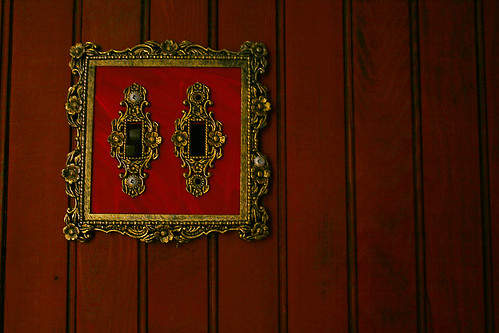
A lightswitch the family room
Exterior cladding on Al's writing shed

5.08.2009

Construction of 'Ways of Life' in Architecture

image from the advertising for the Bohemian Embassy Condos in Toronto from here
Dana Cuff and Russell Ellis point out in their book Architect’s People (1989), that there must always be an “implicit actor who lurks in the designer’s imagination.” The character of this actor affects our experience of the designed space. Crafting a building always involves imagining possible world-creating that could occur within it. Andrew Ballantyne has put this very well when he commented that, “what architects can do in proposing a design for a building, is to propose a fragment of a world.” The induction of delight in a visitor to a building depends on predicting how this fragment of a world will be perceived. The subject experiencing the space may choose to participate in the proposed world, or alternately it may seem discordant to them. If this architectural description of a proposed way of life manages to strike a chord with the subject, this can be one of the most effective means of achieving delight an architect has at their disposal.

Inclusion and Exclusion in the Construction of Place in Architecture

When dealing solely in what David Harvey has referred to as ‘absolute’ and ‘relative’ space, paying attention primarily to issues of ‘firmness’ and ‘economy’, it is easy to end up designing the same building in several different locations. As the logic of capitalism does not necessarily involve any conception of mental or social space, as Juhani Pallasmaa has it, “architecture has lost its contact with its own mytho-poetic ground, the originary acts and images of dwelling and constructing.”[1] Architectural space, emptied of mythos and poesis, understood only in terms of technis, becomes alienated and sterile to the human encounter.

One of the central victims of the technical homogenization of buildings that has persisted throughout the modern period has been that uniquely grounding quality of space that we call place. Place depends on difference. The preservation and construction of a sense of uniqueness and immediacy in the environment is one of the responsibilities of an architect operating in ‘relational’ space (Harvey’s third type of space, of mental, cultural, social, political dimensions). Norberg-Schultz went so far even as to define architecture as the ‘art of place’[2]. But although this engagement with place entails an attention to the historical condition of a territory, this is not at all to say that architects should be wary of change, of the new. The prescription that the architect must engage with how “life takes place”[3] in a given territory, should imply that the architecture must remain open to many different sorts of life that might take place. As the philosopher Albrecht Wellmer wrote in 1988, “the only choice we have is between different directions in which to progress, different directions for change.”[4] The new is compulsory. To not think so is to flirt with the possibility of exclusion. Recognizing that place is a constructed value, the architect must engage with the human subject through architecture so as to augment their constant, active construction of place. But to do so is always dangerous as the fetishization and propagation of what has been is always so very close to limiting the possibilities of what will be. The architect must listen to the past notions of place and use these as the foundations of ever new constructions. As Wellmer puts it: “It is not only people who dream: cities and landscapes and even materials dream, and perhaps it is the task of architects to interpret these dreams and translate them into built space.”[5] Wellmer pleads that architects “have the courage to intervene instead of merely preserving, the courage to pursue the ‘project of modernity’ instead of resorting to the mere gestures of defence, of conservation, of regression.”[6] Only in this way is it possible to have a regional architecture that resists exclusion.


[1] Pallasmaa, ‘Aesthetic and Existential Space’, 1.

[2] Norberg-Schultz, Architecture, 11.

[3] Norberg-Schultz, Architecture, 221.

[4] Wellmer, ‘Architecture and Territory’, 287.

[5] ibid

[6] ibid

5.07.2009

Architecture for Cyborgs

What is the role of architecture in an age when our technology is radically transforming us?

While our technology (and our architecture) has always been closely linked to who and how we are, it seems to be moving increasingly closer to us to the extent that you might even say we are becoming cyborgs! A number of important changes are taking place: the extent that we are becoming embroiled in large unfathomable networks is causing disindividuation and re-mystification; the merger of physical reality with virtual reality (the emergence of mixed reality) together with transcendence of the purely visual interface are causing a more harmonious relationship to develop between mind & body; the split self, or ecological model of self is supported by technologies that structurally divide attention, opening the potential for ironic attitudes towards truth, and more pervasive acceptance of plurality and multiplicity.

The architect can play several roles in all of this.

First, it is the architect’s responsibility to carefully calibrate our relationships with larger ecological networks. Given the alienating potential of digital technology, the architect must pay close attention to the scale of the body (or machine-body, or whatever) – to craft and to detail, and to the sensuous engagement between cyborg machine-body and its immediate ecosystem. The architect must also strive to accommodate those aspects of our cyborg-becoming, as listed above, which offer promise for the future. Our architecture must suit the ironic mind. If it structures a way of living and eternalizes images of the ideal life, let them be tolerant and liberal, and open to multiplicity. If the architect must imply stories in the architecture, let those stories have blurred boundaries and multiple endings. Let them be stories instilled with irony.

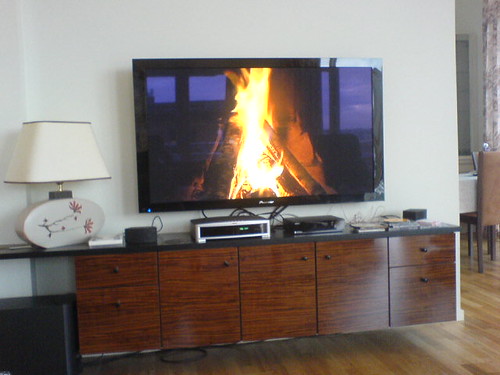
home is where the hearth is

Image taken from here

The fireplace was originally incorporated into buildings in order to keep the indoor environment warm while the temperature outdoors dropped. But it soon came to have a secondary purpose. Being the warmest spot in the house, it became where people would gather. Thus it gained a social function – it became a place for communication and for communion. In an oral culture, the fireplace would have been where common narratives were created and propagated. It was a place of solidarity, a focal point for families and the immediate community. But as technology changed, the hearth changed too. The evolution of indoor heating in the 20th century made the fireplace obsolete in its original capacity. However, largely because of its social function [I think it’s fair to propose that its aesthetic value is linked to its social function], it remained a feature of buildings up until the end of the 20th century. Often, fireplaces were replaced by simulations of themselves such as gas fireplaces. However, the 20th century also replaced the social function of the fireplace. With the popularization of the television, families and friends were soon choosing to gather around it instead of the fireplace. The television became a new sort of electronic hearth.

As with the fireplace, common narratives were created and propagated around the television, although these narratives were being shared on a much larger scale. Also, our engagement with the narratives being spun was far more passive than before. The bodies of television viewers were inert compared to the bodies of those gathered around the fireplace.

Today, the television too is becoming obsolete, with people choosing to go to their computers (and the Internet) for entertainment and communication. For a brief period, as desktop computers, complete with large monitors and ‘towers’, became commonplace, they started to become a new sort of hearth. However, with the progressive miniaturization of technology and the ability for machines to connect to networks wirelessly, desktop computers too are fading away. The hearth, which at one point had been a stabilizing focal point of the architecture, is disintegrating. We carry our hearths around with us in our pockets.

The hearth had served a cosmological purpose, anchoring the immediate community to a place. Solidarity was focused around the hearth, with our networks radiating outward from it. The ecological metaphor of the self as an ecosystem nested within other ecosystems is complicated by the nomadicism of the cyborg at its centre. Now, for an electro-nomadic cyborg, it is as if the world were truly “an infinite sphere of which the center is everywhere and the circumference nowhere,” as Pascal once said. As with the fireplace, our new miniaturized electronic technology allows for communication and communion, and the sharing of common narratives, and it encourages a far less passive body in us than the television or the desktop computer. But in terms of providing a focal point of solidarity for the immediate community, it fails. The new technology still has an alienating component, separating us from our immediate environment while it connects us to larger networks. Architecture gives this level of environment its form, and so architects must respond to this alienation.

Architecture that serves

Architecture is changing along with the rest of our technology. There is the constantly present desire, for instance, for our buildings to be ‘responsive’. Architects, since the beginning of the Modern movement at least, have been incessantly pushing back on the dominating aspects of architecture. In this view, architecture restrains our liberty. It becomes a concrete image of history restricting the freedom of the present. Over time, this desire to free the individual from architecture has taken the form of the open plan, flexible spaces, and temporary buildings that can be reassembled to accommodate changing needs. More recently, architects have been attempting to make architecture that will literally ‘respond’ either to the individual or to other aspects of the environment in real-time. Some examples of this include Jean Novel’s Arab World Institute, where south-facing apertures adjust to levels of sunlight, the MIT-based PlaceLab, where a built-in computer will “sensitively adjust lighting and interior climate in response to your current activities,”[1] and Philip Beesley’s kinetic sculptures, large plastic billowing matrices that move in response to the presence of spectators. Although these projects are very different, they all incorporate contemporary technology to render architecture immediately responsive.


[1] Mitchell, PW, p.64

Architecture as prosthetic membrane; slow architecture vs. alienation

Architecture plays an important role in calibrating our relationships with each other and with the variously scaled networks in which we are enmeshed.

But we shouldn’t think of architecture as just a system of impersonal boundaries. They are actually very personal; these boundaries are very close to our being. As Juhani Pallasmaa has put it, “architecture is the art of reconciliation between ourselves and the world, and this mediation takes place through the senses.”[1] Architecture is at the forefront of our confrontation with the cosmos and should be treated with care.

Architecture has always been close, but as technology increasingly bridges the gaps between the individual and the environment, the design of architecture becomes almost an act of surgery. At the end of the 19th century, Le Corbusier imagined the house as a machine to assist our living. This was a metaphor that represented the machine as separate – a sort of servant to our autonomous humanity. As Anthony Vidler pointed out, the metaphor is changing. Architecture now should be thought of as being much closer to our being than that – as a sort of prosthetic.[2] And indeed, as such visions as the mental control of household appliances via EEG sensors come to materialization, this is no light metaphor – architecture is prosthetic. We are architectural cyborgs.

Now here’s an interesting exercise: If we for ourselves an image of a student in their room at their computer . . . what do we imagine the rest of their room to be like? The room is dark, lit only by the light emanating from the monitor. The student has lost track of time, as David Greenfield, theorizer of the Internet as narcotic, has suggested that he might.[3]

I imagine that the room is largely empty and I imagine that it is a mess. With the amount of attention paid to the world accessed through the windows on their computer, the student has less attention to focus on the environment in immediate spatial proximity to them. As the phenomenon of continuous partial attention causes us to pay less attention to the world about us, it matters a lot less what it looks like. As William James apparently said, our “experience is a narrow thing, bracketed by our own editorial decisions. And it is likewise important to keep in mind the trace that our experience leaves on what we attend to. By observing the space of our hypothetical student, dazed and lost in (or is it on?) the Internet, it is evident that it is not the room that has been experienced; it lacks the trace of dwelling. But, and here is the hope for architects, maybe, the more attention we pay to crafting this immediate level of experience, the room, the more it will have the capacity to bring us back into the present place and moment.

Certain aspects of new technology – the possibilities of haptic interfaces, of a new orality, of mixed-reality, and of the mobility that arises from miniaturization – offer hope of counteracting the alienation from our environment encouraged by so much of our technology. Architects can help wage this battle both by engaging the mind and the body simultaneously and particularly by engaging the body. We need to break through what Mark Kingwell has called the “legacies of abstraction”[4] of the Enlightenment and the ensuing Modern period and ground our expanding phenomenological ecologies in the here and now. Although hearthless, we need to put the rest of architecture to use as we embody ourselves in place.

Perhaps this is why there has been such a resurgence in recent years in interest in the phenomenological understanding of the world amongst architects. As ocular-centric technology has tended to increase our alienation from the ecologies immediately about us, architects such as Juhani Pallasmaa have yearned to reconnect us with them. Perhaps ‘slow architecture’ like that recommended by Peter Zumthor, with its careful attention to dimension and material could be a means of doing this.


[1] Pallasmaa, EOTS, p. 50

[2] Vidler, p. 147

[3] Greenfield, p.17

[4] Kingwell, p. 212