5.28.2009

Of the Cyborg and the Hermit

I would like to introduce you to two radical images: the Cyborg and the Hermit.

The realm of the cyborg (Haraway) is a highly artificial realm, a realm in which everything is constructed, including what we sometimes call nature. Nothing is pure, everything is transfigured by the curious and unstoppable winds of contingency. The cyborg has no original or everlasting centre. For the cyborg, a creature of communication, objectivity has been replaced by ‘intersubjectivity’ (Rorty). The cyborg is thus pragmatic and accepting of the contingency of its thrownness.

The hermit is everything that the cyborg is not. The hermit seeks the authentic and the real, wants to touch the soil with his fingers. The hermit dreams of home and paradise lost. The hermit seeks to reclaim a lost unity.

Where the hermit relishes in their own fallibility, the shortness of their arm and the limits of their vision becoming badges of their humanity, the cyborg replaces its parts as they fail, extending their reach through vast wireless networks and extending their life into the future. The hermit is nostalgic, but not the cyborg who associates nostalgia with death and for whom the past is gone.

Hand of the Future?

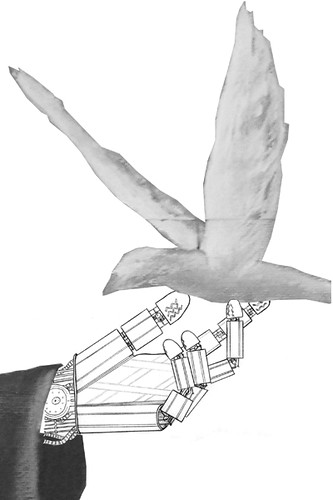
Back in February I posted an image of a painting I had recently completed entitled Cyborg St. Francis. A friend recently referred to this painting, which I have hanging in my office, as a bit of a riddle. I think this is totally fair, and although it wasn't intended as a criticism the observation points to a perpetual problem I have with my various attempts at 'art' - a whole bunch of the cerebral and a relative deficit of clarity. While I suppose I come about this honestly (most of my favourite art works in this way), it flies a bit in the face of the purpose of the art which is supposed to give me an opportunity to escape the linguistic, to engage with something more 'phenomenal'. If the end result of the work is perceived as the eliciting of an explanation (the solving of the riddle), then the work is not operating as it should. More on this here.
The original work was supposed to address (and the fact that the starting point is an idea might be part of the problem here) our relationship with 'nature' and how this changes as we become increasingly technological beasts.
The following three images are a continuation of this investigation:


In a future where you can buy various types of replacement hands, maybe one of them could be a 'birders' model! In the end, yes, becoming cyborgs changes our relationship with everything, including birds, but maybe this change could actually improve the possibilities of connection.

5.22.2009

Photographs from Al Purdy's A-Frame

A couple of months ago I was lucky enough to gain access to the keys to Al Purdy's famous A-frame, the house that he built for himself and his family in Prince Edward County in the 50's. If you don't know who Purdy is, you should find out here. There is currently quite a concerted effort to raise money to purchase and fit-out the Purdy A-frame for the purpose of using it for a writers-in-residence program. If you're interested in this, the webpage for the A-frame Trust is here.
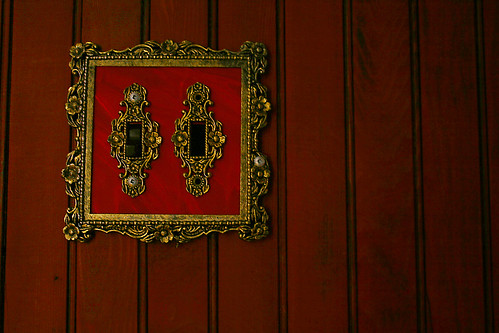
While at the A-frame I attempted to undertake something of a portrait of the A-frame including measured drawings and photographs. Below are a few of the photos I managed to snap:

Some books in the bedroom
Exterior detail
A lightswitch the family room
Exterior cladding on Al's writing shed

5.08.2009

Construction of 'Ways of Life' in Architecture

image from the advertising for the Bohemian Embassy Condos in Toronto from here
Dana Cuff and Russell Ellis point out in their book Architect’s People (1989), that there must always be an “implicit actor who lurks in the designer’s imagination.” The character of this actor affects our experience of the designed space. Crafting a building always involves imagining possible world-creating that could occur within it. Andrew Ballantyne has put this very well when he commented that, “what architects can do in proposing a design for a building, is to propose a fragment of a world.” The induction of delight in a visitor to a building depends on predicting how this fragment of a world will be perceived. The subject experiencing the space may choose to participate in the proposed world, or alternately it may seem discordant to them. If this architectural description of a proposed way of life manages to strike a chord with the subject, this can be one of the most effective means of achieving delight an architect has at their disposal.

Inclusion and Exclusion in the Construction of Place in Architecture

When dealing solely in what David Harvey has referred to as ‘absolute’ and ‘relative’ space, paying attention primarily to issues of ‘firmness’ and ‘economy’, it is easy to end up designing the same building in several different locations. As the logic of capitalism does not necessarily involve any conception of mental or social space, as Juhani Pallasmaa has it, “architecture has lost its contact with its own mytho-poetic ground, the originary acts and images of dwelling and constructing.”[1] Architectural space, emptied of mythos and poesis, understood only in terms of technis, becomes alienated and sterile to the human encounter.

One of the central victims of the technical homogenization of buildings that has persisted throughout the modern period has been that uniquely grounding quality of space that we call place. Place depends on difference. The preservation and construction of a sense of uniqueness and immediacy in the environment is one of the responsibilities of an architect operating in ‘relational’ space (Harvey’s third type of space, of mental, cultural, social, political dimensions). Norberg-Schultz went so far even as to define architecture as the ‘art of place’[2]. But although this engagement with place entails an attention to the historical condition of a territory, this is not at all to say that architects should be wary of change, of the new. The prescription that the architect must engage with how “life takes place”[3] in a given territory, should imply that the architecture must remain open to many different sorts of life that might take place. As the philosopher Albrecht Wellmer wrote in 1988, “the only choice we have is between different directions in which to progress, different directions for change.”[4] The new is compulsory. To not think so is to flirt with the possibility of exclusion. Recognizing that place is a constructed value, the architect must engage with the human subject through architecture so as to augment their constant, active construction of place. But to do so is always dangerous as the fetishization and propagation of what has been is always so very close to limiting the possibilities of what will be. The architect must listen to the past notions of place and use these as the foundations of ever new constructions. As Wellmer puts it: “It is not only people who dream: cities and landscapes and even materials dream, and perhaps it is the task of architects to interpret these dreams and translate them into built space.”[5] Wellmer pleads that architects “have the courage to intervene instead of merely preserving, the courage to pursue the ‘project of modernity’ instead of resorting to the mere gestures of defence, of conservation, of regression.”[6] Only in this way is it possible to have a regional architecture that resists exclusion.


[1] Pallasmaa, ‘Aesthetic and Existential Space’, 1.

[2] Norberg-Schultz, Architecture, 11.

[3] Norberg-Schultz, Architecture, 221.

[4] Wellmer, ‘Architecture and Territory’, 287.

[5] ibid

[6] ibid

5.07.2009

Architecture for Cyborgs

What is the role of architecture in an age when our technology is radically transforming us?

While our technology (and our architecture) has always been closely linked to who and how we are, it seems to be moving increasingly closer to us to the extent that you might even say we are becoming cyborgs! A number of important changes are taking place: the extent that we are becoming embroiled in large unfathomable networks is causing disindividuation and re-mystification; the merger of physical reality with virtual reality (the emergence of mixed reality) together with transcendence of the purely visual interface are causing a more harmonious relationship to develop between mind & body; the split self, or ecological model of self is supported by technologies that structurally divide attention, opening the potential for ironic attitudes towards truth, and more pervasive acceptance of plurality and multiplicity.

The architect can play several roles in all of this.

First, it is the architect’s responsibility to carefully calibrate our relationships with larger ecological networks. Given the alienating potential of digital technology, the architect must pay close attention to the scale of the body (or machine-body, or whatever) – to craft and to detail, and to the sensuous engagement between cyborg machine-body and its immediate ecosystem. The architect must also strive to accommodate those aspects of our cyborg-becoming, as listed above, which offer promise for the future. Our architecture must suit the ironic mind. If it structures a way of living and eternalizes images of the ideal life, let them be tolerant and liberal, and open to multiplicity. If the architect must imply stories in the architecture, let those stories have blurred boundaries and multiple endings. Let them be stories instilled with irony.

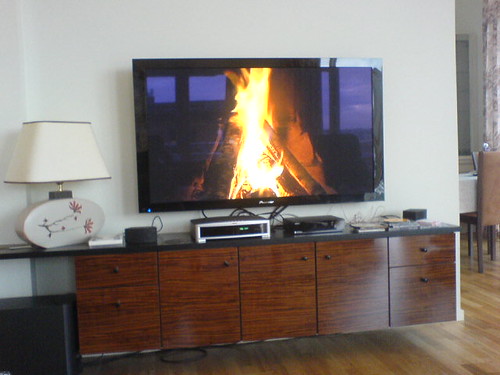
home is where the hearth is

Image taken from here

The fireplace was originally incorporated into buildings in order to keep the indoor environment warm while the temperature outdoors dropped. But it soon came to have a secondary purpose. Being the warmest spot in the house, it became where people would gather. Thus it gained a social function – it became a place for communication and for communion. In an oral culture, the fireplace would have been where common narratives were created and propagated. It was a place of solidarity, a focal point for families and the immediate community. But as technology changed, the hearth changed too. The evolution of indoor heating in the 20th century made the fireplace obsolete in its original capacity. However, largely because of its social function [I think it’s fair to propose that its aesthetic value is linked to its social function], it remained a feature of buildings up until the end of the 20th century. Often, fireplaces were replaced by simulations of themselves such as gas fireplaces. However, the 20th century also replaced the social function of the fireplace. With the popularization of the television, families and friends were soon choosing to gather around it instead of the fireplace. The television became a new sort of electronic hearth.

As with the fireplace, common narratives were created and propagated around the television, although these narratives were being shared on a much larger scale. Also, our engagement with the narratives being spun was far more passive than before. The bodies of television viewers were inert compared to the bodies of those gathered around the fireplace.

Today, the television too is becoming obsolete, with people choosing to go to their computers (and the Internet) for entertainment and communication. For a brief period, as desktop computers, complete with large monitors and ‘towers’, became commonplace, they started to become a new sort of hearth. However, with the progressive miniaturization of technology and the ability for machines to connect to networks wirelessly, desktop computers too are fading away. The hearth, which at one point had been a stabilizing focal point of the architecture, is disintegrating. We carry our hearths around with us in our pockets.

The hearth had served a cosmological purpose, anchoring the immediate community to a place. Solidarity was focused around the hearth, with our networks radiating outward from it. The ecological metaphor of the self as an ecosystem nested within other ecosystems is complicated by the nomadicism of the cyborg at its centre. Now, for an electro-nomadic cyborg, it is as if the world were truly “an infinite sphere of which the center is everywhere and the circumference nowhere,” as Pascal once said. As with the fireplace, our new miniaturized electronic technology allows for communication and communion, and the sharing of common narratives, and it encourages a far less passive body in us than the television or the desktop computer. But in terms of providing a focal point of solidarity for the immediate community, it fails. The new technology still has an alienating component, separating us from our immediate environment while it connects us to larger networks. Architecture gives this level of environment its form, and so architects must respond to this alienation.