I'm currently going through some old files and have come across a veritable mountain of old abstracts and proposals that I have written over the last few years for this that and the other. Some of them really read like short essays. It's a bit sad looking at them because, while I'm pleased that I had the opportunity to thing these thoughts, will in the end just get lost, read only by myself, my beleaguered editor-partner and the person doing the vetting for whatever prize, program, publication or conference it was that I was applying for. So, while it is vulnerable to the charge of the very worst sort of navel-gazing, I'm tossing them up here in this new project that I am calling 'The Graveyard of Dead Abstracts".
4.17.2011


Why Architects Should Care About The Al Purdy House
The following is a piece that I wrote some time ago about the Al Purdy House and its potential for architectural inspiration. I came across it shuffling through some old files today and thought that while old it is still worthy of tossing up here. Enjoy!
It looks like the house built by the poet Al Purdy may no longer be in danger of demolition.
Architects should rejoice at this news. Although it might not be apparent at first, this rather ramshackle A-frame shell has the potential to teach us a great deal about the very intimate relationship that a person can develop with their house, especially if they design and build it themselves, as in Purdy’s case. While this may seem antithetical to the practice of architecture, if we are interested in how our buildings frame people’s lives then we could stand to learn a great deal from paying close attention to artefacts such as this house which constitute intense sites of dwelling. The intensity of Purdy’s dwelling, by which I mean the specific emplacement of his life in Prince Edward County in Ontario, the sort of living that could not have occurred elsewhere, is revealed in his poetry, which makes frequent reference to the house.
In a way, Purdy was a real architect’s poet. A lot of his best work has to do with preparing the land and building things. In his poem ‘The Country North of Belleville’ he writes, And where the farms are / it’s as if a man stuck / both his thumbs in the earth and pulled / it apart / to make room /enough between the trees / for a wife / and maybe some cows and /room for some / of the more easily kept illusions, evincing his keen interest in settling, both making him pertinent to architects and making him a very Canadian poet. Canada remains a continuously settled territory. We currently accept around 250,000 new immigrants per year after all, each of whom must partake in some form of settling: of sticking their thumbs into the fabric of what is to make room for their new foundations.
In Purdy’s poetry there are two primary architectural themes: an old derelict mill, his Tintern Abbey, the carcass of which he returns to over and over again as a means of accessing the past, of accessing those who have come before; and his own house, built largely out of re-claimed materials on land that he cleared himself. He effectively plays these themes off of one another, one being a sign of the past and the other a gesture towards the future. In his poem, ‘An Arrogance’, he refers to building his house as changing the contour of the earth, and fencing-in, even abstracting a portion of the sky, a very grand, even hubristic declaration of his presence on earth. This subtle negotiation of the old and the new which runs throughout his life’s work should be a dance very familiar to architects.
And in this house, this peg on which to hang the ego, where, as he once wrote, the door knob was a handle he held onto the sky with, Purdy transitioned into being more than a mediocre poet, in fact in this house he became a great poet. Despite travelling all over the world and eventually moving to the west coast, the A-Frame is both where he wrote his best poetry and is the frame against which much of it is set. It rightly deserves to be a national monument. It was not so long ago, however, that the fate of this house was in jeopardy. After Purdy died in 2000, his wife, now in her mid-80’s, could only hang onto the place for a few more years before the ongoing battle to keep it from returning to the soil became too much. Fortunately her very threat of putting the property on the market, which would have inevitably led to the house’s destruction, caused such a wave of outrage from those of us interested in Canadian letters that it was quickly taken off of the market. This wave eventually built into a full-on formal campaign to save the house, obtain heritage designation, and turn it into a writer’s retreat for up-and-coming talent. This effort has resulted in a string of fundraisers as well as a recently-published monograph on the house containing drawings, photos, reminiscences and essays, the proceeds of which will go towards the house’s preservation and maintenance.
Let us hope that this fascinating architectural site remains accessible for many years to come, and also that it will continue to evolve in new and unexpected ways along with its new program as young writers encounter it and alter it through their own intense dwelling.
Anyone interested in the campaign to save the house can find out more by visiting the site, http://www.alpurdy.ca.
6.16.2010
Grooveshark Album Wars
Labels:
playlist,
prose _ nonfiction
A few years ago I transferred all of the mp3 music on my computer onto my portable hard drive. I did this with the idea of freeing up memory on my computer for other stuff including use as virtual memory. This move now, however, leaves me in a rather original spot. It has been some ten years since I had a computer that wasn't overflowing with music. In the interim years such a situation, having no music whatsoever on my computer, would have been intolerable to me. I used to joke that my laptop was really just an oversized mp3 player. Today, however, I hardly even notice the lack, and this has little to do with a weakened desire to listen to music, although perhaps I have grown less needy for the music drug during my long emergence from adolescence. Rather, it has more to do with the presence in my life of a stronger drug, an omnipresent high-speed connection to the internet.
It could be said, perhaps, that a large part of the addictiveness of the internet has to do with its ability to bundle many other drugs into itself. All day long when connected to the internet my addiction to acknowledgement and approval causes me to obsessively check my email. My addiction to fascination causes me to watch news and blogs like a hawk for out-of-the-ordinary stories. My tendencies towards voyeurism are satisfied in all sorts of ways online: reading comments on news and blog sites, watching my facebook feed, youtube, and my addictions to melody and rhythm are now satisfied by a constant ability to reach out into the ether and access any song that I can think of.
To satisfy this urge for immediate gratification of the need for the music drug I used to have to keep on my hard drive a gigantic collection of songs, and constantly be maintaining this by acquiring new music that I come across. But now websites like Grooveshark allow me to get this immediate gratification without having to maintain my own personal collection. It depends on a steady and large supply of bandwidth (I imagine [who am I kidding, I have now idea]), but it completely revolutionizes my relationship to the music, far more I think than the shift from CDs to mp3s. That first shift was a shift from the corporeal manifestation to the digital representation. With mp3s we still treated the songs as 'objects' which we had to acquire and store in our 'folders' and then play in our music machines. Streaming is different because I never acquire the music, but rather just access it. My taste is the only thing that limits my experience of music and the ability to acquire is taken right out of the equation.
Anyhow, all of this is to introduce a new game that I have cooked up within Grooveshark, which I am calling Album Wars. The idea is simple - you take two albums and you create a playlist with all of the songs on both albums and then you shuffle the songs to get unusual juxtapositions and pairings. This game is fun because it allows you to create comparisons in a more or less uncontrived fashion (the shuffling is random) between two artists probably working at different times. I am having such fun with it I thought I would share. Here are the ones I have created so far - some more successful others less:
The Sound of Face Control:
Jesus and Mary Chain - The Sound of Speed (rel. 1993)
Handsome Furs - Face Control (rel. 2010)
Cohen Were Here
Leonard Cohen - Songs of Leonard Cohen (1967)
Sarah Harmer - You Were Here (2000)
Raineing on my Wolf Parade
Our Lady Peace - Clumsy (1997)
Wolf Parade - Apologies to Queen Mary (2003)
Tongued Odelay
Talking Heads - Speaking in Tongues (1983)
Beck - Odelay (1996)
Maybe whoever happens upon this might have some suggestions of other odd bedfellows that they can recommend? Liam? Geord? Nils? Vien?
It could be said, perhaps, that a large part of the addictiveness of the internet has to do with its ability to bundle many other drugs into itself. All day long when connected to the internet my addiction to acknowledgement and approval causes me to obsessively check my email. My addiction to fascination causes me to watch news and blogs like a hawk for out-of-the-ordinary stories. My tendencies towards voyeurism are satisfied in all sorts of ways online: reading comments on news and blog sites, watching my facebook feed, youtube, and my addictions to melody and rhythm are now satisfied by a constant ability to reach out into the ether and access any song that I can think of.
To satisfy this urge for immediate gratification of the need for the music drug I used to have to keep on my hard drive a gigantic collection of songs, and constantly be maintaining this by acquiring new music that I come across. But now websites like Grooveshark allow me to get this immediate gratification without having to maintain my own personal collection. It depends on a steady and large supply of bandwidth (I imagine [who am I kidding, I have now idea]), but it completely revolutionizes my relationship to the music, far more I think than the shift from CDs to mp3s. That first shift was a shift from the corporeal manifestation to the digital representation. With mp3s we still treated the songs as 'objects' which we had to acquire and store in our 'folders' and then play in our music machines. Streaming is different because I never acquire the music, but rather just access it. My taste is the only thing that limits my experience of music and the ability to acquire is taken right out of the equation.
Anyhow, all of this is to introduce a new game that I have cooked up within Grooveshark, which I am calling Album Wars. The idea is simple - you take two albums and you create a playlist with all of the songs on both albums and then you shuffle the songs to get unusual juxtapositions and pairings. This game is fun because it allows you to create comparisons in a more or less uncontrived fashion (the shuffling is random) between two artists probably working at different times. I am having such fun with it I thought I would share. Here are the ones I have created so far - some more successful others less:
The Sound of Face Control:
Jesus and Mary Chain - The Sound of Speed (rel. 1993)
Handsome Furs - Face Control (rel. 2010)
Cohen Were Here
Leonard Cohen - Songs of Leonard Cohen (1967)
Sarah Harmer - You Were Here (2000)
Raineing on my Wolf Parade
Our Lady Peace - Clumsy (1997)
Wolf Parade - Apologies to Queen Mary (2003)
Tongued Odelay
Talking Heads - Speaking in Tongues (1983)
Beck - Odelay (1996)
Maybe whoever happens upon this might have some suggestions of other odd bedfellows that they can recommend? Liam? Geord? Nils? Vien?
3.11.2010
Bedroom Mirror
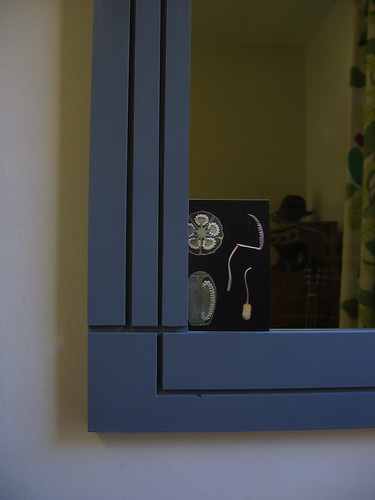
Here's a couple of photographs of the mirror that I made for our bedroom in Cambridge. The room was quite small and we felt it needed something to make it seem bigger. These pictures are actually in our new Toronto apartment where it serves the same purpose. Oh - and for you literalists out there, I didn't make the mirror itself, just the frame.


3.02.2010
Cyborg Domesticity Images
Labels:
collage,
cybernetics
Below you will find the images that I produced to accompany the paper that I presented in Venice in December at the First International Conference on User-Centric Media. The paper was about the traditional behavioural and symbolic role of the hearth in the house and what the potential fate for this is in an increasingly nomadic age. The images hence represent three semi-whimsical attempts to imagine technologized portable hearths:
 Nomadic spaces such as an airport waiting area can be very disorienting.
 What if you could access your own personal existential grounding tool through your smartphone?
 What if you could share that with others, creating a focal point for gathering?
 Perhaps you could use this nifty little smartphone easel in order to do this.
 Alternately maybe some sort of infrastructure is required in order to orchestrate communal gathering and sharing of narrative (creating cosmologies in common within which to situate us).
 Couldn't this commuter infrastructure do with a little hearth?
 Like this? Rather than everyone concentrating on their own little windows into their own little worlds, maybe they could all plug in their smartphones into this infrastructure in order to create something akin to a hearth where these disparate worlds could be blended, remixed into something new.
 It could look something like this for instance.
 Or maybe, rather than a fixed infrastructure, it could be portable, like this router.
 This fabric router can be unrolled onto the ground, kind of like a picnic blanket. It would create a local network for digital communication between nomads and then it could create a shifting, dynamic image out of the information flowing through it. Again, our worlds are shared and remixed, sort of similar to the effect of sharing stories around a fire. . .
 Perhaps such a technology could look something like this.
 Nomadic spaces such as an airport waiting area can be very disorienting.
 What if you could access your own personal existential grounding tool through your smartphone?
 What if you could share that with others, creating a focal point for gathering?
 Perhaps you could use this nifty little smartphone easel in order to do this.
 Alternately maybe some sort of infrastructure is required in order to orchestrate communal gathering and sharing of narrative (creating cosmologies in common within which to situate us).
 Couldn't this commuter infrastructure do with a little hearth?
 Like this? Rather than everyone concentrating on their own little windows into their own little worlds, maybe they could all plug in their smartphones into this infrastructure in order to create something akin to a hearth where these disparate worlds could be blended, remixed into something new.
 It could look something like this for instance.
 Or maybe, rather than a fixed infrastructure, it could be portable, like this router.
 This fabric router can be unrolled onto the ground, kind of like a picnic blanket. It would create a local network for digital communication between nomads and then it could create a shifting, dynamic image out of the information flowing through it. Again, our worlds are shared and remixed, sort of similar to the effect of sharing stories around a fire. . .
 Perhaps such a technology could look something like this.
2.12.2010
Having Mastered Architecture, a website
Labels:
link
I am conscious of my drop in production (curation? publication?) at this site recently, but I have been very busy with other things and generally my production of things has dropped off a bit. Hopefully this will change in the near future.
In the meantime you can check out my new website at http://dprpatterson.com if you are interested. Making this html monstrosity has been a primary reason why I have not been posting things here recently.
Probably the most interesting things on the new website are my recent academic work. This includes my article on Purdy, some photos of my Purdy exhibit that I showed in Cambridge, the extended abstract of the paper I presented in Venice in December (with images, which I will soon post here as well) and my thesis document, which can be found there in its entirety.
Oh, and did I mention that I mastered architecture? I finally submitted my thesis to the University of Waterloo, officially, at the end of January.
In the meantime you can check out my new website at http://dprpatterson.com if you are interested. Making this html monstrosity has been a primary reason why I have not been posting things here recently.
Probably the most interesting things on the new website are my recent academic work. This includes my article on Purdy, some photos of my Purdy exhibit that I showed in Cambridge, the extended abstract of the paper I presented in Venice in December (with images, which I will soon post here as well) and my thesis document, which can be found there in its entirety.
Oh, and did I mention that I mastered architecture? I finally submitted my thesis to the University of Waterloo, officially, at the end of January.
11.04.2009
More Pictures from the Cyborg House
Labels:
collage,
cybernetics,
photos
I recently defended my Masters Thesis in Architecture. In preparation for this, unbeknownst to my committee I spent quite a bit of time preparing these images as illustrations of what the house of the future might be like. To those unfamiliar with the project it's important to keep in mind that I was not reinventing the whole house, just pieces of it, so do not be alarmed by the baseboard and hardwood flooring :)
Also, just to be clear, this is whimsy:
 mirror of the future
 hearth of the future
 toilet of the future
 table of the future
 bed of the future
 window of the future
 cabinet of the future
Also, just to be clear, this is whimsy:
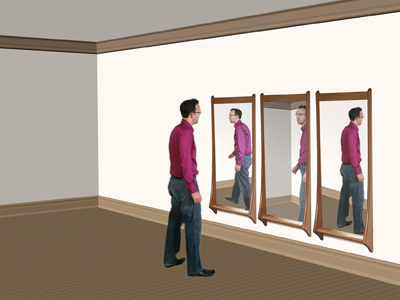 mirror of the future
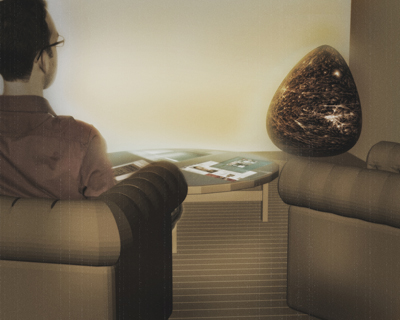 hearth of the future
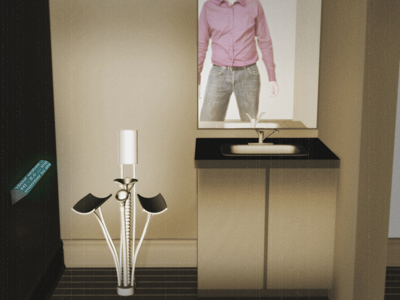 toilet of the future
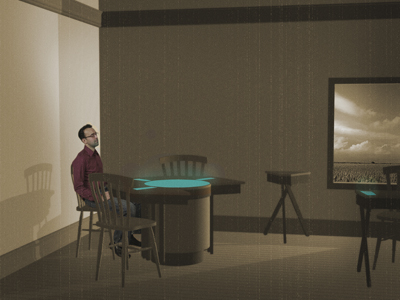 table of the future
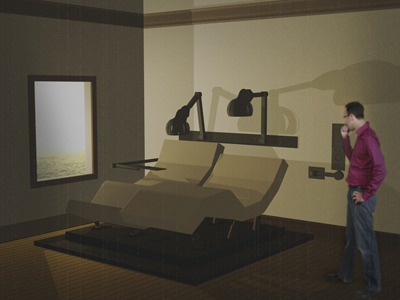 bed of the future
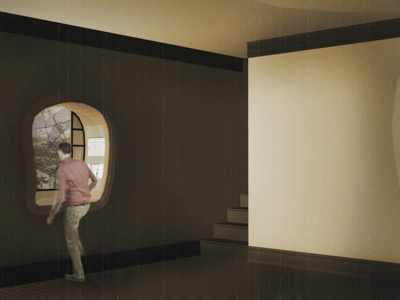 window of the future
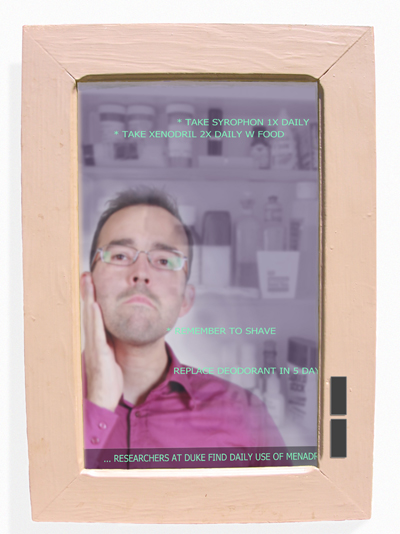 cabinet of the future
Subscribe to:
Posts (Atom)

