About a month back Google announced a major settlement with publishers and the Authors Guild, in which the representatives of the publishing industry agreed that it was alright for Google to be trying to 'scan' every book ever produced, as long as they offered the copyright holders a percentage of the profits made off of the work, as well as payed them a one-time scanning fee. This is a hackneyed version of the actual 134 page agreement, but not inaccurate I don't think.
Now it appears that not everyone is happy about this. A group of interested persons, including the American Library Association, The Institute for Information Law and Policy at The New York Law School, and a consortium of lawyers are now planning on raising their objections to Google's plan. Just to give you an idea of what their knickers are all twisted about, the key words in the debate appear to be things like monopoly and anti-trust.
In my mind the problem doesn't just involve the books thing, it involves Google's position as the sometime owner of content but more often distributor and 'organizer' of content from maps to news to blogs to images to videos etcetera and etcetera. This blog, for instance, although the content belongs to me, is saved on memory that belongs to Google. My email also is all saved on a server owned by Google and is accessed through a program designed and managed by Google. Stepping back a few decades it is as if my filing cabinet belonged to someone else, and also my bookshelf, and also my photoalbum and my vhs collection!
My own very simple formulation of the problem is like this:
Google's mission statement is 'to organize the world's information'.
Organization is a form of control.
Knowledge is power.
Absolute power corrupts, absolutely.
We can trust Google, right? They're basically a philanthropic organization, right? Well, maybe, and no. I think I would not be amiss if I said that history teaches us that it is abject foolishness to trust anyone that has immense amounts of power. Perhaps the founders and executives of Google are in possession of ideals that I share - this is not reason enough to blindly trust them. First of all I cannot be sure beyond a doubt that my ideals are less likely to cause pain and more likely to cause universal prosperity and suffrage than others' ideals. And second of all, Google neither has these goals as its mandate nor is it a democracy (such as the common goals of the group may be upheld) - it is a frankly profit-driven corporation.
So, I think its great that we have a system in place (or at least the Americans do) that allows us to challenge things like this and also that we have people willing and interested enough to challenge them. I only wish that there was greater concern about it circulating. These are very serious issues that need to be attended to with great thoughtfulness and dexterity. The system of information is becoming dangerously unbalanced - kudos to the librarians and to the lawyers for keeping an eye on it for us.
4.04.2009


3.31.2009
Densification, Technologization, Commodification, Existential Crisis, Phenomenology, Dharma, and Buildings . . . all the good stuff
Labels:
prose _ nonfiction
The truth is that our contemporary world, technologized and structured by the commercial logic of late capitalism, is not conducive to meaningful dwelling, especially not in large urban centres. The goal of inhabiting meaningfully is made problematic by many factors which pull us into a space both intellectualized and also devalued by material justifications and goals. Ontological problems which initially arose out of mechanization and commodification have been exacerbated by the electronic and ensuing digital technology of our age. Space-time compression, the genesis of competing virtual domains (competing both with each other and with the real), and the full enframement of existence within material and economic logic makes our inhabitation of the world increasingly difficult to conceptualize and, indeed, to build for.
This ungrounding of existence partially accounts for the recent resurgence of interest in phenomenological method both in philosophy and in architectural theory and practice. The Husserlian prescription to go ‘to the things themselves’ through an encounter with phenomena presents a potent attraction as we find ourselves pulled from our direct experience of the world by the immense abstract networks to which we are tied and upon which we are increasingly left to rely for meaning. Phenomenology, with its insistence upon direct encounter, opens up alternate routes to meaning which evade the systems of meaning interwoven into our systems of production, consumption and exchange.
Interestingly, the texts of Buddhist philosophy, dharma, with their emphasis upon mindful presence, present a corollary to phenomenology seen in this light. Buddhist scriptures, for the most part written 2500 years ago, caution against the dangers both of material ensnarement and intellectual abstraction. This anticipates Husserl's response to the continuous clashing of idealists and materialists in their various incarnations throughout the history of Western philosophy that his school of phenomenology was intended to be. Dharma, in a way actually similar to phenomenology, offers us a way to reconnect with the basic problems of dwelling. And (interesting to an architect interested in using phenomenology in architecture), dharma has two distinctive building types associated with it intended to serve its practices: the Buddhist temple and the monastery.
And Buddhism in China is booming. In response to the collapse of Marxist ideology, to increasing economic prosperity (and disparity), and to technological enframement, the Chinese are flocking to religion. Currently the practice of choice for 10 million Chinese people, Buddhism is the fastest growing religion in the People's Republic of China. This is a sea-change for a country that not so long ago villainized all religion. During the years of the Cultural Revolution, for example, the beautiful Jing 'An Temple in Shanghai operated as a flour mill. Tellingly during this period the images of Buddha were replaced with images of Chairman Mao. Now, however, it has been restored to its original purpose, one of a total of 30 temples in Shanghai restored and renovated during the five years between 2001 and 2006.
As China rapidly develops and its population moves en masse to the city, Buddhism is rapidly gaining popularity. Both Buddhism and urban density are growing, simultaneously. But Buddhist temples and monasteries have traditionally been spacious places of respite from the world, sites of quiet and secluded practice. It is as of yet unclear how these sorts of buildings will be incorporated into the megacities of tomorrow. They may remain as focused centres of retreat, their sacred precincts defiantly empty in the midst of rapid development. On the other hand, temples could scatter, and, adjusting to the changing spatial economics, find themselves in unexpected locations such as old office spaces 23 floors above grade. Could we imagine a monastery adjusted to fit the 20th through 25th floors of an office tower, right above an IT company and below a PR firm, the lotus pond and bamboo grove on the roof accessed by elevator? I don’t see why not, but the metamorphosis of the typology would present a serious challenge.
3.25.2009

3.04.2009
Google Wants To Give You Some Money
Labels:
link
I posted here back in November about the settlement that had been reached between Google and representatives of the 'print industry'. I find this to be totally amazing: essentially in this deal, which still requires in-court approval, we are witnessing, as if it was being played out for us in a play, the final crisis of the take over of print media by digital media. Now all we will have left is the end-game, the tidying up of loose-ends, the denouement.
See the New York Times here for the most recent news. Google is making a monumental attempt (ironically using large-scale printed advertisements [its a bit like slapping someone with their own hand, no?]) to contact all copyright holders. Why? To give them some money.
Google, as part of its mission to organize all of the world's information, is intending to scan everything that was ever published in print-media. So if you've ever published anything, they want to give you some money, both a) right off the bat for the right to scan, and b) every time someone pays them to read it.
Of course, the really big thing we should be aware of here is: if print media has fallen, both absorbed by and also made obsolete by the digital, what's next? What exactly is going on here?
Go to the article for more information.
2.23.2009
St. Francis as Cyborg
Labels:
painting

After he found that people would not listen to him, the Catholic saint, Francis of Assisi, preached to the birds instead. Iconographically in Catholic art he is often represented with birds and / or with a wolf. His hand and his temples are also usually depicted as displaying the bloody evidence of his stigmata. The image above is actually based upon an iconic image of St Francis (which I found on the internet through a Google search, but cannot for the life of me find the author!). I have always been attracted to images of St. Frank. Although I am aware that this is not entirely rational, part of this attraction has to do with his relationship to animals - he seems compassionate towards and, of all of the saints that I am aware of, more in touch with 'nature' (by which you could read a more progressive characterization such as 'the larger ecosystems of which he is a part', if you like, but saying things like that gets so damn awkward). This painting wants to address the issue of how our changing relationship with technology changes our relationship with 'nature'. Embedded in this is also a question about representation and how it relates to power and control, which is why I chose to also include the photorealistic representations of animals alongside my rather rudimentary acrylic sketches.
2.20.2009
On the Utility of Images
Labels:
prose _ nonfiction

(The Anatomical Theatre of Leiden, by Swanenburgh, 1616)
Over the years people with severed corpus callosums have taught us a lot about how our brains work. The c.c. is the part of the brain that connects the left hemisphere [the notoriously more analytic and linguistic part of the brain] with the right hemisphere [the part of the brain that handles emotions, images and intuition]. People whose two sides of their brains don’t talk to each other thus provide very useful information on how the two hemispheres are specialized. I was recently reading about a study for instance that had some very interesting implications for understanding the process of post-rationalization. In this particular study, conducted by Michael Gazzaniga of the University of California at Santa Barbara, a subject was shown the word ‘walk’ directly to his left eye, connected to the right hemisphere of the brain. Suddenly he got up and started to walk off. When asked why he had got up, he answered, ‘oh, I wanted to get a coke’. The left brain, which had seen the word, was incapable of producing any kind of justification, while the left brain, which had no idea about the command, was given the task of producing an explanation, and immediately did so. The subject fully believed his own story.
I find this weird and unnerving. It raises the possibility that maybe the part of me that I know best, the logical and linguistic side, is actually only making things up to cover the real intentions brewing in my right brain. Is this possible? Given this framework, it indeed could be that this ‘self’0 that I understand, that navigates life based on a series of logical and reasoned decisions, is actually a fabrication devised to ground whims that are in fact unbeknownst to me.
Which lends, does it not, an interesting aura to any discussion of zeitgeist, or any other residual meme of fate, religious determinacy, and the Hegelian Spirit? Think for instance of the visionary painter, following his instinct, creating masterpieces that seem to flow forth from him. Years later, people will look at the painting and see things moving in it which relate clearly to other aspects of culture and to cultural manifestations yet to emerge. In their spontaneous creation, artists often seem to be channelling something deep and important to their era, something that probably could not be articulated in a medium suited to analytic thought (such as the philosophical essay, for instance). Within this framework of hemispheres sketched above it is possible to conjecture that the painter’s right brain was in touch with a larger cultural ebb of non-verbal ‘information’, or maybe it’s better to say emotion, that his left brain was clueless about. Perhaps in addition to the dominant narratives through which understand our epoch there is a parallel non-verbal cloud into which we are also tapped, similar to a zeitgeist. I’m not presenting this in any way as the truth of the matter, but rather just pointing it out as an interesting way of thinking about things that is incidentally opened up by this bi-cameral model of cognition.
I am however interested in the utility of both image-creation and the discussion of images. In Bachelard’s introduction to his wonderful Poetics of Space, he says a couple of things that have stuck with me in this regard: first, that, ‘the poetic image places us at the origin of the speaking being’; and second, that, ‘poets and painters are born phenomenologists’ (a line that originates from Van den Berg). I think this is inspirational, and has inspired me increasingly to try to work with images in my own explorations. Perhaps this is a sign of an overactive left brain here, but for me this kind of talk provides a legitimation of image-play. For me these two observations of Bachelard’s open up image-play as a legitimate way of thinking.
Now maybe this sounds totally naïve, but I find it very useful to change my thinking around so that image-creation is a justified counterpart to analytical inquiry – to think that they could co-operate without one dominating the other. In the past, my love of art has often been centrally focused on what I could squeeze out of it: how many different ways I could think about it or how many different interpretations I could construct out of its material. The realization here is said better I think by Mark Kingwell when he comments that art ‘is never reducible to its mere propositional content – thinking so marks one of the ways we do violence to the aesthetic’ and continues to say that it ‘carries substance of a kind that could not be carried in any other way.’ [Opening Gambits, 2008] Thinking about art as the support of analytic inquiry or as somehow incomplete without it is to denude it of its rightful majesty and to deny that there is any sort of thought which cannot be expressed in the language of the philosopher, bureaucrat or scientist, which is just not true. Art doesn’t just serve thought, it is a form of thought.
Personally, I want in my approach to have a closer affinity to the artist than to the scientist. By this I mean that I wish to rely more heavily on internal rather than external observation. The artist (like the phenomenologist) believes in the usefulness of personal exploration – which of course requires a belief in the overlap of selves, a belief in the commonalities between us. The scientist, in contrast to this, relies on external observations of others to arrive at their conclusions about humanity. In this sense, in my work, I would like to take the stance of the artist and look within, in full recognition of my subjectivity, rather than review things from an ‘objective’ external observational standpoint.
Which is not to say that I reject that standpoint. I think the scientific method has produced and will continue to produce an absolutely astounding quantity of profound insight into our various human predicaments. As has the analysis of art, too. In fact one of the amazing things about art is I believe its capacity to provide for a wide diversity of thought. In fact as Kingwell has written elsewhere, ‘aesthetic success hinges on how much the work opens up, rather than closes down, the spaces of thought and wonder.’ [Monumental/Conceptual Architecture, 2004] In this sense art does in fact serve thought. It stimulates and encourages thought on a wide variety of important subjects.
Which all goes to explain why I am focusing much of my energy right now on the creation of images. The thesis document that I’m thinking of producing I hope to see as a sort of ‘table’, a bit like an operating table, but also like a coffee table. On this table I hope to place a series of images so that they can be seen in juxtaposition to one another and against a common background. I also hope to place narratives on this table, and myths, as well as facts gleaned from others’ scientific investigations. And then I’m going to mix all these things about, and flip them over each other and smash them into each other! And through these ‘table operations’, I hope to create a useful appraisal of my subject-matter that furthers our understanding of it and our capacity to act thoughtfully and intelligently with regard to it.
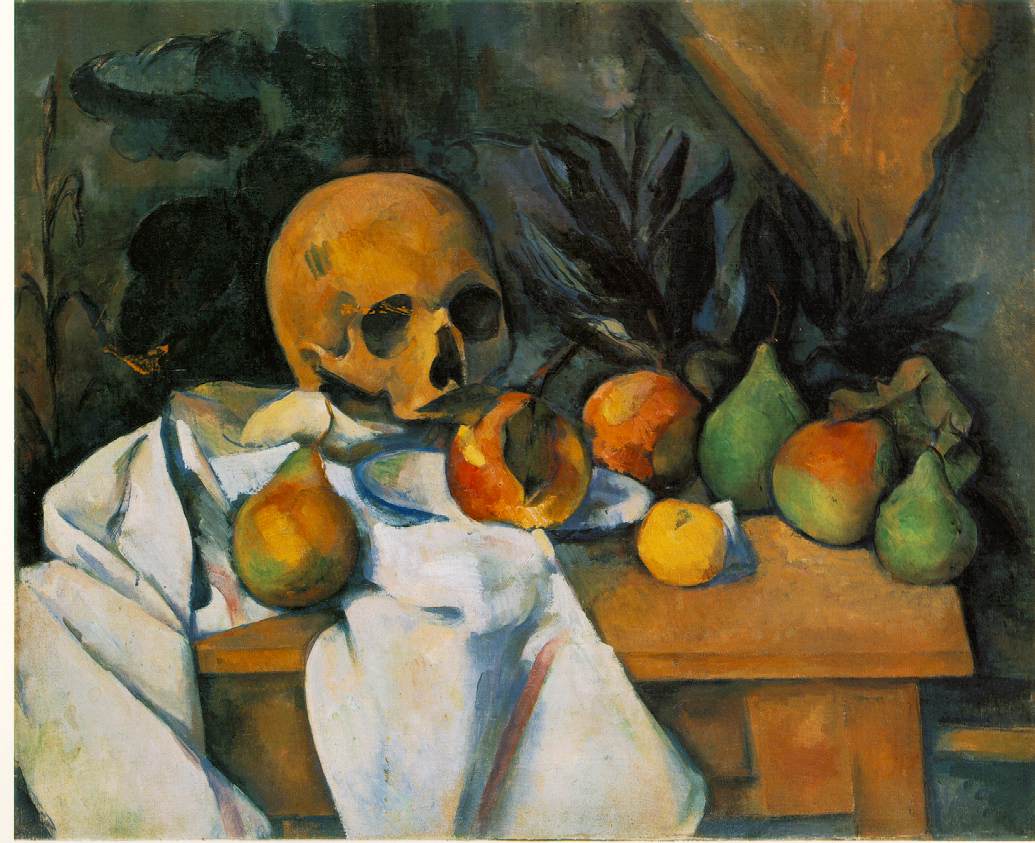
(Still Life With Skull, Paul Cezanne, 1895-1900)
Working Abstract and Title for Thesis
Labels:
prose _ nonfiction
Revised: October 14, 2009
Title:
Between Technological Flesh and the Technological Field
a phenomenology of the interior
Abstract:
Title:
Between Technological Flesh and the Technological Field
a phenomenology of the interior
Abstract:
In a time of swift and radical technological change this thesis seeks a re-appraisal of the phenomenology of the house. Canonical phenomenology has been notably technologically averse and the phenomenological appraisal of the house, as offered by philosopher Gaston Bachelard (1958) and architect Juhani Pallasmaa (1994), has left technology out. This thesis asserts that neither the technologization of the flesh nor the field can be ignored. Upon asserting the importance of both technology and the house to our Being, the thesis proposes some basic principles for understanding technological change. A re-appraisal of the phenomenology of the house is then initiated, starting with a selected series of behavioural and symbolic foci: the hearth, the toilet, the table, the bed and the window. These are discussed with regard to their historical importance in the house and speculated upon as they become increasingly technologized.
This thesis takes the form of a book. It is a synthetic and removed work, navigating the overlapping zones of a number of disparate discourses. Its perspective is situated in the midst of many complex and interconnected metaphors. It is part historical description, poetical observation, philosophical conjecture, curation, and design.
Subscribe to:
Posts (Atom)

