2.09.2009

Shape and Size

A poem! This relates directly to the last two posts.


I see myself in everybody else;

my face is in their face,

my eyes are in their eyes.


Blue skies and white,

beyond, my soul;

I feel my blood in

the veins of trees;

I have mountain shoulders.


And yet

so much solitary

in this solidarity.


Out we come

from earth and flesh

in so many shapes and sizes;

this is my shape and size.


This is my shape and size?

reflected in a mirror or in a stream

or a storefront window,

this is my face?

this is my nose?

this is my voice?

that’s what my eyes do?


Don’t you know that

I AM the world?

on a clear day,

the sun is in my chest;

I feel rain under my skin;

my tears stain the sky.


The world is a tortured mirror;

I am so big small.

Body Deconstruction Chamber

This is the second of two projects (the first is here) dealing with body image and sense of 'self'. This project proposes that it is better to have a solid sense of individual subjecthood in the privacy of your home, but when you leave your home you should let go of this, becoming plural and flexible. The Body Deconstruction Chamber is thus an anteroom that attempts to facilitate this gradient. All of those squiggly lines in the room are mirrors, of different shapes and sizes and contortions. When leaving the bedroom the first thing you are confronted with is a large ordinary mirror, but then as you move through the room, this solid image of self is morphed and fragmented. Similarly, approaching the room from the other angle, you begin with a distorted image and by the time you actually enter the bedroom you are accompanied by a solid, simple reflection.
As usual, click on the image for the full thing.

plan

perspective sketch

Body Image Construction Tryptic

This as well as the next post display images from a couple of recent design projects I have completed - this one is called the Body Image Construction Tryptic. The idea is really simple, that a room, a bedroom in this case, is fitted out with cameras that display images of what is going on in the room on a couple of lcd screens mounted on (or in this case in) the wall. It is an extension of the notion of having a mirror in your room so that you can inspect what you look like to other people. Thus, beside your direct reflection are displayed two images of you from other angles.
Foucault speaks in his
Of Other Places lecture (pub. 1967) of how a mirror, 'makes this place that I occupy at the moment when I look at myself in the glass at once absolutely real, connected with all the space that surrounds it, and absolutely unreal, since in order to be perceived it has to pass through this virtual point which is over there.' He also speaks of the act of 'reconstituting' yourself where you are, the mental act of positioning yourself.
I find it fascinating how the mirror can take you out of yourself to see yourself from another perspective, a perspective that is simultaneously objective and impossible. I also feel that looking in a mirror is interesting because in it you are related to your context in a way you otherwise wouldn't understand.
Besides this, three other points of interest lead to this design. First is the fact that people who suffer from anorexia actually see themselves as fat even when they are painfully thin. Second, I find it fascinating how a person suffering from phantom limb syndrome can ease the pain or itch in their missing appendage by holding a mirror in front of themselves so as to trick their brain into seeing a limb where it is not. Third, I find the ability of actors, dancers and other such performers to be in complete control of how they appear to others to be amazing. The tryptic, which I feel is actually kind of perverse, is designed to increase body awareness and to construct a stable image of self in relation to context.

plan, tryptic at bottom

elevation of tryptic

Cyborg Headset and Robotic Hand Studies

The following are imaginary renderings of what a cyborg headset and a robotic hand might look like. I've made them as preparatory sketches for a painting I am currently working on.


2.08.2009

A Record Quarter for Television

The New York Times is reporting today on the persistence of television watching despite the collapse of other forms of what they are calling 'old-media'. I'm not sure if anyone else feels this way, but personally I've gotta say that I find the description of any means of communication and entertainment that is not somehow connected to the Internet as 'old-media' gives me a bit of vertigo!

Apparently, according to Nielson, in the quarter that ended September 30th, 2008, Americans watched an average of 142 hours per month, up 5 hours from the previous year. And that's the summer, too! Meanwhile over the same period Internet use averaged out at 27 hours monthly, up an hour and a half from the previous year.

And why are we so "smitten with screens"? Apparently it is because print takes too much thinking, and "because the text mode is now used so infrequently that it can feel like a burden". Instead apparently the population is leaning more and more over to video - even on the primarily text-based Internet people are tending more and more to prefer their content in the form of moving images such as provided by YouTube. This is why, then, according to the article, newspapers and publishing houses are suffering (as old-media companies) but television is not. It remains an easily accessibly 'immersive experience'. And this is apparently what we want, not to visit our media with a polite objective eye, but rather to bathe in it.

2.07.2009

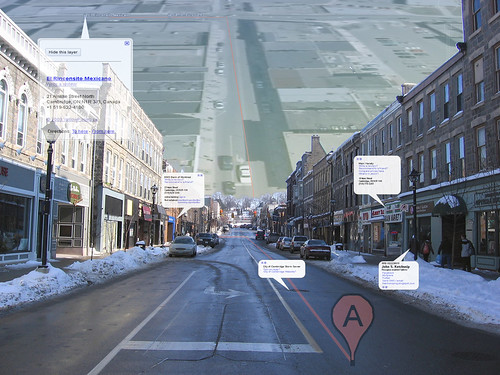
Mixed Reality on Main Street, Cambridge


Above (click here for a larger image) is an illustration of what might be referred to as 'mixed reality', a reality in which the distinction between the informational models, traces and shadows of the world (as found on the internet) and the world itself (physical phenomena) begins to erode. What does it feel like when information begins to be layered over our phenomenal experience of the world? Smart phones are getting more and more applications that blend these realms. Their abilities to be located spatially using gps, to record light using their 'camera' chips, and also record sound greatly increase their usefulness at linking up things in the physical world with things in the digital domain.
A San Francisco based subsidiary of Yahoo! called Fire Eagle offers a service that seems to epitomize this sort of blending. Either you intentionally input your spatial location into their system or you set up some device associated with you (like your smart phone) to do this automatically. Once your location is registered in their system, it updates the applications you have decided to use (on your smartphone or your laptop, etc.) which allows them to provide you with the sort of spatially-appropriate information that you are interested in. As of right now Fire Eagle has 61 such applications available for download from their 'gallery', mostly for social-networking purposes, tourism, etc.

2.04.2009

Webgaze?

4 personal observations:
When I used to sail boats one of my favourite sensations was of standing up while working the tiller;
when I go hiking I relish the experience of standing high up on a rock and looking down over a landscape (not unlike that famous painting by Caspar David Friedrich);
I am a cartophile – I love reconciling my phenomenal experience of space with the abstract world that is delineated on a map;
finally, when I arrived in Rome last spring I made a concerted effort to avoid maps, entirely navigating the city by landmarks and their perceived relation to my body – it was fun, often disconcerting, and frequently stupidly inefficient.

I like to navigate, I like to look out to and down at the world, and I like to piece things together in my mind. Successfully working my way through a foreign city using a map gives me great pleasure, reconciling the real space with the diagram, recognizing the major monuments and formations, and finding my way amongst them.


Reading Roland Barthes’ brilliant commentary on the mythic dimension of the Eiffel Tower, I was recently reminded of all of this and how the image of Apollo has helped us to talk about these feelings. Apollo, sungod to both the Greeks and the Romans, saw the world from above, a perspective both similar to that afforded by the Eiffel Tower (a truly extraordinary perspective in 1889) and by a map. In Greek mythology, the birds’-eye perspective was only available to gods looking down from Olympus and by Apollo soaring through the sky. Because of this, the view from above has often been referred to as the Apollonian view. When man attempted to move in on this territory, in the form of Icaraus, he was punished, his waxen wings melting and himself tumbling down. Maps have allowed man to approximate Apollo’s perspective without leaving terra firma. And what a feeling it must have been, drawing that first map – discovering how to represent a vast territory in miniature. From this Apollonian perspective, things are seen ‘objectively’, laid out as objects in clear relation to one another. Apollo was thus associated by the Greeks with the analytical, understood in contrast with the emotional, which they associated with Dionysus, the god of earthly pleasure.


Barthes says of looking down and out from the Eiffel Tower that it inspires decipherment, a process of moving your eye across the panoramic view searching for things and reconciling it with your other phenomenal experiences of space. He speaks of a reconstitution of Paris in your mind; looking down over the city, we recreate it in our mind in a new form. This is a very powerful position to be in. Reconstituting an entire city in your mind is a very powerful act, the act of a god even. It is also a highly intellectual act, and in his text Barthes goes so far as to even say that, “in a sense, that is what intelligence is,” implying that somehow this act of reconstitution is very close to the primal roots of how intelligence itself operates. But it is also a very particular type of intelligence, the type that was coming truly into its own with the historicist, acquisitional, and adventurous mindset of the 19th century, the time of the great all-encompassing scientific and philosophic theories, the museums of artefacts from all over the world, and the burgeoning fascination with flight. As Giedeon has pointed out, it is no surprise that “Santos-Dumont chose to circle about this tower on his spectacular flight in his airship.” In the 19th century the spirit of Apollo was in the air and was very much appealed to both by the tower and by the possibility of flight.


But what is of interest to me here is how all of this differs from the experience of being on the Internet. The new ‘networked’ perspective is very different – the perspective of the internet flaneur is far more like being inside of something than looking down upon it. While controlling a web-browser can seem quite similar to captaining a ship sometimes, it lacks some of the authority of what we might call the Ahab or Odyssean Perspective, standing high on the poop-deck battling through the waves of stubborn fate. It is perhaps more like being in some sort of control-room, and I’m thinking here of that sort of control room depicted in Hollywood movies where there are hundreds of ‘monitors’ – this association between power and the ability to see many things at the same time. But again, the experience of being IN cyberspace, or ON the Internet, lacks the sort of detached authority that this image would suggest.


Using tools like Google Maps, there is definitely a flavour of the Apollonian, but there are two qualities to the experience that alter this. The first quality is the very real vastness of the information at hand and its apparent infinity. The overwhelmingness of this ocean of data surges up in the face of our confident seamanship – it takes on a mythic dimension: a lurking Poseidon in those unseen 13,541 search results! The ability of Google to give us so many results is nothing short of a brain-fuck – the results are simultaneously quantifiable and unfathomable.

The second quality that counteracts, or at least noticeably adjusts the Apollonian view is the virtuality of digital information. On Google Earth you can crawl the surface of the world, which of course seems like a very godlike think to do – but wait! it’s not the real world: ce n’est pas un pipe, madame! This is intangible, placeless, disembodied data. You may feel like you are bigger than the earth, scrolling around it like it were a toy ball, like with little more than an idle thought you can see and understand things that are massive, complex, and completely outside of your habitual sphere of exposure, influence and interest (anything you want to know about explained in 2000 words, thank you Wikipedia). You may feel that way, but then the power goes out and you’re sitting at home alone in a dark room. The universe that you were a master of was a fake.

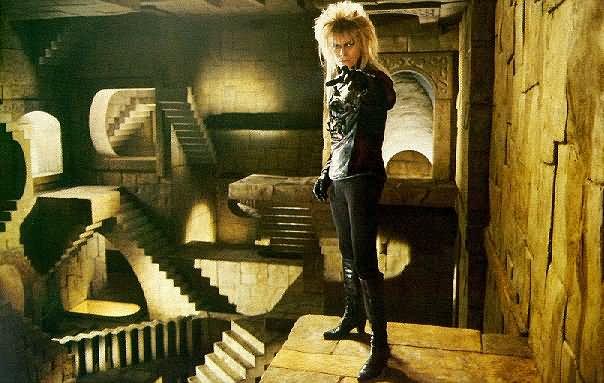
So it remains an open question for me, what is the experience of being on the Internet like? If the image of Apollo is useful for understanding the intellectual exercise of looking down, deciphering, and ‘reconstituting’ the world, what image could describe the webgaze? Is it Dionysian? Is the Internet a labyrinth, or maybe an ocean? Perhaps the image of Ahab battling through the waves in search of his Moby Dick is useful, but then again isn’t the association between the Internet and nature pretty problematic? It’s something to think about anyways.

.