1.30.2008

Shibboleth by Doris Salcedo

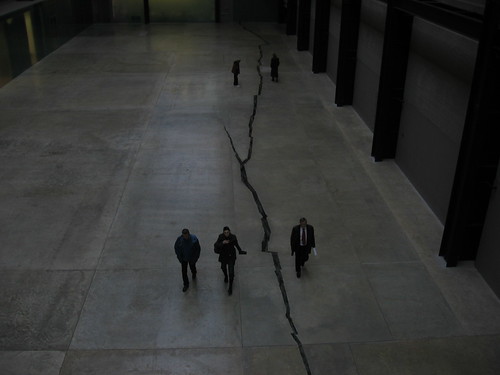
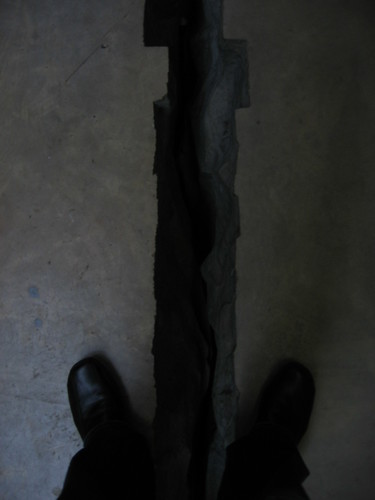
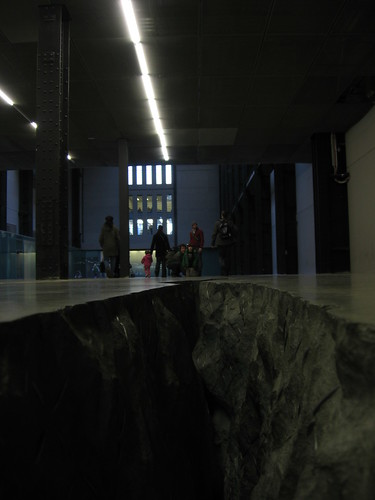
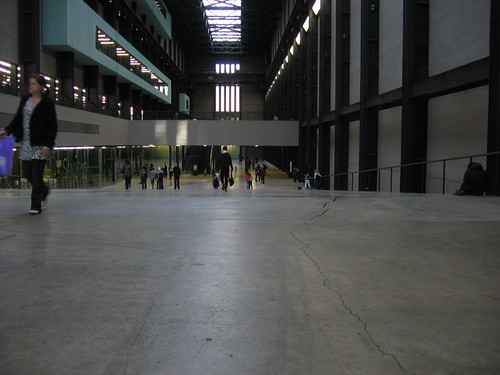
This exhibit is currently on in the Turbine Hall at the Tate Modern in London. It consists of a crack in the floor.


"That's how the light gets in" - Leonard Cohen


The crack in the precast concrete floor is fastidiously sculpted so that one edge mimics precisely the variation of the other, giving the impression that it is the product not of a bursting from within or an impact but rather from two opposing forces, pulling apart.


The crack gives the impression of being able to look below the historical surface. When you look below, however, there is just more concrete.


The word Shibboleth refers to a word that divides or distinguishes people.


Salcedo seems to see this as a reference to a crack in modernity and in colonial heritage.


People seemed to like to follow the crack on foot, tracing its undulations, rather than look at it from above.

Garbage in Rome and London for Chloe

In London they eat your rubbish.


At the train station in Rome, terrorism shows you your trash.

1.26.2008

From the Tate Modern

Just arrived in Rome - here is a picture from the 4th floor of the Tate modern.

1.23.2008

The Gunner Table

I'm currently in London, UK, sitting in my friends' flat. Although yesterday was sunny and blue-skied, today it is a more typical gray and slightly wet London Day.
Before I left Canada I finally managed to complete the work I was doing on Geordie and Robin's table that I gave to them as a wedding present in July. Aye aye aye, it has been a continuing saga, but now at least the construction and the finish is complete. Now I just have to get it out to Edmonton. Here are some pictures I took . . .


11.27.2007

Industry's Last Movement


I just finished reading a highly provocative interview with Bernard Stiegler in the Fall issue of the Queen's Quarterly. I found it to be a very potent analysis of capital in a contemporary setting.

It got me thinking. According to Stiegler, the quantifying and disindividuating effects of capitalism reduced the craftsmen to proletarians and eventually managed to replace them more or less altogether with mechanical technology. The same thing has happened on the other side of the supply-demand relationship as well. Citizens were reduced to "consumers", cogs in the industrial process. Consumers have been denuded of identity and meaning by the arithmetic logic of capitalism. Socialists would tend to think that the way out of this is to turn away from capitalism. Many would suggest that we need to turn to other things such as religion or nature to re-establish a sense of meaning.

But maybe there's another answer. Rather than fighting it, perhaps we should let this disembodied spirit of Capitalism have its way and let it complete the process of industrialization. We have industrialized harvesting, processing, manufacturing, distribution, even the commercial side of consumption. But the actual act of consumption has been largely left alone, human in its inefficiency! It seems like the best way to finally free humans from the reductionist effects of capitalism is to complete the industrialization of the economy: that is right, I am talking about Consumption Machines! Nothing else would break us so decisively free, allowing us to go romping in the meadow at sunrise. We would be free at last from our obligations to the economy!

The picture above is from the Cloaca project, where they have been well ahead of me in designing these sorts of machines. The link: http://www.cloaca.be/
I'm very impressed by their work, which manages replicate a digestion process, but what I'd like to see is a machine that will also look at advertising, watch tv, surf the net, read books, listen to music, experience a museum, etc. . . now that would be a true consumption machine.

11.17.2007

Defeating the Dark [side]

Our glorious Ontario Fall, while clinging on for an unseasonably long time this year, is falling. Winter approaches, quickly chasing. Although yesterday's first snow fall in Toronto was really just a few small flakes, it felt momentous nonetheless.

There is a long tradition of celebrating light in the wintertime, when, in the Northern hemisphere at least, the amount of natural light significantly diminishes. The lack of natural light provides us with the opportunity to celebrate our ingenuity in creating light. While our celebrations of light have many individual significations, together I feel they also represent humanity's capacity to rise above naturally-imposed difficulties, a certain technological optimism, and human solidarity amidst darkness. Examples of these traditional celebrations range from the Jewish Honukkah, the Indian Diwali, the Persian Chahārshanbe-Sūri, the French Fête des Lumières and the Germanic precursors to Christmas.

These traditions, linked by their appreciation of our ability to create light in the face of impending darkness exemplify how some symbols can transcend geography, nationality, and religion to evoke the universals of the human experience. Like how Hallowe'en costumes and decorations have adapted over the years from the traditional ghouls and devilish characters to include characters from the popular media such as Frankenstein, Dracula, and now even includes items such as security tape, reminiscent of CSI, so, we continue to forge new celebrations of light.

I took this picture at Notte Bianca in Rome, 2005

Nuit Blanche is one notable international example of a new celebration of light, where people stay up all night, often accompanied by many light-related art installations. In Toronto we also have the Cavalcade of Lights, a wintertime and Christmas-related series of projections, lighting displays, and fireworks.

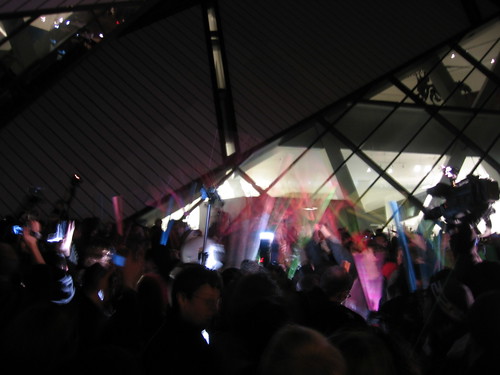
Last night in front of the ROM occurred a new sort of light celebration, and one totally in keeping with this lineage of traditions. Far from a tradition, it was organized in a very brief amount of time on the Internet. Newmindspace's Lightsaber Battle drew over 2000 people to the small public square sheltered under the precipitous juttings of the new ROM renovation.

It was a tremendous time, with a great deal of communal positive energy. Together, people were vigorously battling darkness both real and metaphorical with their brightly coloured cardboard tubes. What I loved most about the event was that, while many would worry that people could get hurt at an event such as this, nobody did. Except in a few notable exceptions, where people really made it very physical, most people spent the time standing upright close together twirling their 'swords' in the air. The swords thus hit each other in their simultaneous radial movements - constituting a 'battle'.

In the few situations where people made it physical, it remained good natured, if frenetic. Even at one of the points where the battle seemed most like a mosh-pit, action was seen to come to a complete pause when someone's glasses fell to the ground!

Indeed, this new form of quasi-spontaneous event is I think a new manifestation of the same instincts that lead us to string our houses with little brightly coloured lights or light bonfires in the streets. It symbolizes that we are together in this; creating light, we can take shelter from the natural darkness.

To see more photos from the event, visit http://www.flickr.com/groups/newmindspace/pool/
11.12.2007

Of Wal-Mart and the OMB


The Ontario Municipal Board is no stranger to the opposition faced by Wal-Mart in rural Ontario. Wal-Mart’s acquisition in 1994 of most of Canada’s Woolco stores had mainly situated them in suburban areas. Given their experience in the US, they knew that they could also play the rural game well. So Wal-Mart has for some time been aggressively chasing the markets of small-town Ontario. However, while Wal-Mart wants nothing more than to make love to rural Ontario, it seems that pretty much every time they make an overture, there is a group of citizens ready to try and rebuff them.

Stratford has been one notable example of this phenomenon. A few weeks ago, their municipal council, after long and highly controversial deliberations, refused to allow the planning amendment required for Wal-Mart to move in. Wal-Mart is now expected to make an appeal to the OMB.

Unfortunately, the usual arguments against allowing Wal-Mart into Ontario's smaller towns, centring on the degradation of local communities and cultures, usually fall on deaf ears at the very business-minded OMB.

An interesting article in the Star recently showed however that a new line of defense against the big box bullies is being tried out. As the people of the town of Port Elgin take on their local Wal-Mart development, they are focusing less on the muddier areas of how the Wal-Mart form of commerce will affect the community, but rather on issues of safety.

This is made possible by the 2005 Provincial Policy Statement issued by the Ministry of Municipal Affairs and Housing, to which the OMB is obliged to respect. Amongst other things, the 'Statement' claims that "Healthy, liveable and safe communities" are sustained by "avoiding development and land use patterns which may cause environmental or public health and safety concerns."

While clauses like this one are probably intended to cover planning debacles like the Oak Ridges Moraine, they do suddenly make the development of 'safe' space a provincial issue.

The urban designs that tend to go along with big-box developments require large parking-lots that are empty most of the time. These are not safe spaces, goes the argument, and therefore should either be redesigned as safer or disallowed entirely.

I, for one, have never seen this argument levelled against big-box urbanism before, but I like it because of its potential usefulness. Unfortunately, however, the solutions that are being proposed in this instance are rather unsavoury. The experts at the OMB hearing are suggesting that Wal-Mart increase visibility by getting rid of trees that surround the parking lot and increasing the proposed lighting. In the interests of safety, the commercial experience is thus being made both less pleasant and less environmentally sustainable.

While the safety argument against big-box stores is interesting, I think the conclusions are wrong. This sort of urban design as I've seen it practiced throughout the province is fundamentally unhealthy to both the individual and the community. If Wal-Mart wants to integrate itself into the local economy, why can't it also be asked to integrate itself into the local urban fabric rather than landing itself on a huge empty lot on the outside of town?

Surely that would be a better solution for 'public health and safety'.

Photo by ChrisEvans