11.02.2007

A New Marginal Fear For You


For whatever reason, it is never the big problems that really get to me. I'm less worried about the several world wars that seem impending on the global stage, the decline in the education of the west, the creeping fundamentalism and radicalism (both nationalist and religious) all over the world, or the increasing rates of violence and and mental illness in the west.

The problems that always seem to attract my attention the most are the unexpected ones, the global problems that seem to sneak in from the flank. Take for instance the bee situation.

We were just going along minding our own business - then, seemingly out of nowhere, we have a bee crisis on our hands! Suddenly (things always seem sudden when presented in the news) the bee population is dwindling dangerously, and David Byrne is quoting Einstein as saying that 4 years after bees go extinct, humanity is doomed. An apocalypse on the horizon, out of left field: Here we were concentrating on pacifying rogue states and cutting our carbon emissions, when it turns out the real doomsday was going to come from the disappearance of beehives!

Since then, we have discovered that the culprit behind the hive scarcity was a virus. So we can stop worrying about that now . . . maybe we haven't solved the problem, but we found a cause - you can sleep easy.

I have also always been fascinated by the apparent effect that cow flatulence is said to have upon global warming. I mean, it sounds like the punchline to a joke, but yet its a very real threat. And now we can add to this . . .. get ready for it - Mammoth Dung! Yes, it's the very latest thing in paranoia - if you're the sort of person who likes to get worried, you can forget about your cancer causing vitamin d deficiency that you got from wearing sunblock, or the hazardous chemicals leaching out of the water bottle that you bought in order to facilitate your heart-disease fighting exercise - the latest fad in fear is the apparently catastrophic effect that melting prehistoric poo is going to have on our climate! Talk about an unexpected (and hilarious) apocalypse. . ..

Here's the link: http://www.reuters.com/article/newsOne/idUSL1076886120070917?sp=true

picture of mammoth remains by Linksmanjd

10.10.2007

The 'Welcome' Screen

Why is it that when I turn my computer, it wishes me, "Welcome"?

What an appropriation that seems. It is as if the computer engineers actually believed that the non-space of the operating system were the privileged world, & that I am simply a visitor to their ethereal realm. As if the only world wasn't the world of air, earth, fire, water that I move in, but actually that this intellectually wrought imaginary world of their creation, complete with its spatial and temporal metaphors, was actually in some sense, more authoritative.

As I understand it, I sit in the real world observing a screen that displays a complex system of allegory, that I (still independent of the system), can then sift through at my leisure.

Should I not be welcoming the computer into existence as I draw electricity surging through its circuits, bringing it into operation? Not the other way around? It seems to me that there is a clear subversion of agency here, manifested in that one word, "Welcome".

I may have bought the computer, set it up, and turned it on, but according to its programming anyways, it is the host, and I the guest.

The Mind and the Body - a little spiritual rant

Yeah true, I get a bit heavy sometimes . . . but I wrote this the other day & thought maybe people would like to read it.

The world is plural & has multiple meanings and interpretations in the mind, but in the body it has unity & universality. For this reason, wisdom is found in a balance between the mind & the body's observations - little justice can be found in universal rules & narratives, but confusion & hollow placelessness is found in the exclusive acceptance of multiplicity.


Both the acknowledgment of universality & of plurality are important in life. They are mutually stabilizing.

There are two ways of understanding the relationships between these acknowledgments: either complex, paradoxical plurality exists within universal reality, or the appreciation of plurality exists above or external to the whole.

I think both of these models have their share of accuracy, & neither of them sums up the relationship perfectly. In the one model, the stable and inclusive whole contains an inherent complexity, rife with internal contradictions. In the other model, the complexity perceived by the intellect exists 'in addition to' the central kernel of stability perceived by the body [including the physical matrix of reality].

While understanding & perceiving the connectedness of things allows us both to love unconditionally & safely in addition to developing a sense of position in the cosmos, the mind's ability to perceive difference allows us to accept others, demonstrate humility, & make decisions that are rational, pragmatic, & fair.

Picture of carrot slice by Mimi_K

9.24.2007

Orchestrating an Acoustic Riot

The Cinematic Orchestra creates complex, vibrant music. Although their most recent effort, Ma Fleur pales in comparison to their previous stuff, this does not stop it from being great music.

They miraculously combine an at times Lynchian obscurity with a film noir, polished savoire faire. They evoke both the words "camp" and "refined" simultaneously. These are confusing descriptions, I understand, but I insist that this confusion arises inevitably from their work, which is pluralistic and vast, at times ironic, at times erotic, at times chaotic, at times meditative. Imagine Humphrey Boghart in a Michel Gandry film. CO flirts with John Coltrane funky freneticism, Miles Davis calm, classical composure, and ties it all together with the smooth drum and bass sensibility of electronica and hip hop. And the beautifully rich vocals of Fontella Bass don't hurt.

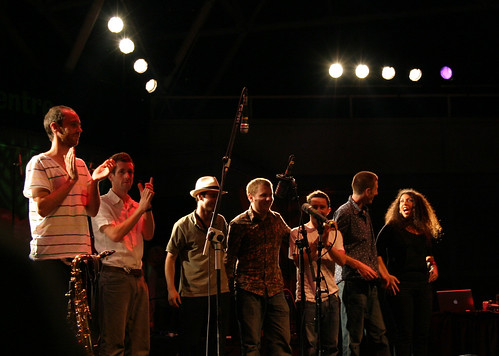
As awesomely put together as their recordings are, the CO are also a true pleasure to see perform live, as they did Sunday night at the Phoenix, here in Toronto. It was definitely the best live show I have experienced in the last year, which is saying quite bit, given that that comparison includes TV on the Radio, Clap Your Hands Say Yeah!, and The Arcade Fire. For me, the most notable thing about their performance was their obvious sheer delight in each other's abilities; their enjoyment of one another's capacity to excel. They looked like they were having a great time, playing old tunes together that allowed each of the very talented musicians to jump in there and have a blast.

Also interesting is that although the project is obviously guided by the 'band leader', J. Swinscoe, there seems to be absolutely no resentment, which is not always the case. Just judging from their onstage interactions, it seems to be a wonderfully collaborative environment, mutually beneficial to all the members of the group.

Photo by El Dudero

9.04.2007

Opinions Are True

It should be noted that this isn't about anyone in particular - its about the question of when opinions become fact. And of course all kinds of other things, like shoes, and goo.

She claims her opinions are true,
and I don't know what to do.

And my fresh bouquet is now askew;
I can't find my way out of this political zoo;
I'm looking for answers, but there are not a few,
and the baddies never seem to get their due!

And she claims her opinions are true?

And in the end its a Nike shoe;
we'll see how much honour a man can accrue;
if you're looking for the wealthy, they already flew,
and the seat that you offer's all covered in goo!

I completely forgot to close the flu,
and there's hundreds of banknotes,
and they all smell like poo.
The fat bearded doctor has a bagpipe tattoo,
and this lovely fresh bouquet is breaking in two!

And she claims her opinions,
mind you not a few -
are true!

And the sky has turned green,
I see trees of blue,
and my communist cousin has fled for Peru,
and Winnie and Piglet, and
Kanga and Roo,
All stare with amazement at this murky stew.

And the answers keep coming -
they are not a few;
the judge and the jury, paralyzed by the view,
have thrown out the old, to favour the new.

But in conclusion, although all this is true,
I can relax in my hammock without feeling too blue. . .

I mean,
at least my opinions are true!

7.07.2007

Jon Sasaki

I really really like the work of this artist, Jon Sasaki.


He has a show on right now in Toronto at Gallery TPW. I haven't been to it. But I read an article about it, and then I visited his site, which I highly recommend to you as well:


http://www.jonsasaki.com

His video work is the best, I think, but all of the stuff on the site is great! It's ironic without seeming contrived; it drifts into the uncanny without being overly serious; it's referential without being redundant.

6.03.2007

ROM, June 2007

Back when it was first announced in 2002, my gut reaction to the ROM renovation was immediately negative. I am, however, coming around to passivity.

When I examine my own intial response, I think it can be summed up as a reaction to its "irresponsibility" as architecture, similar to the cotemporary addition to the Ontario College of Art and Design. I was responding to a feeling that the lack of civic responsiveness and respectability in the execution of these designs was a flagrant violation of the seriousness of Architecture. While by no means have I changed my mind about the lack of urban sensitivity and refined sensibility (lets face it, the crystal is gaudy, like a fat diamond ring!), I have seriously softened my demand for these things as obligations to either the architectural profession or to society. I can accept this "architecture as reaction" or this "architecture as spectacle" or this "architecture as personal expression", whatever you wish to denote it as, insofar as they represent voices in a necessary built dialogue. In other words, I can respect what the architect, Libeskind, and his team think they are doing and their vitality and energy in attempting it, whether or not I respect the final form. I am willing to admit this as a concession to plurality in the built environment.

Libeskind feels a need to break down the rectilinear and cellular structures of traditional museums. This is in keeping with a fairly noble idea of reinventing and loosening up the rigid story-lines we associate with the curation of knowledge. He wants, I believe, to architecturally represent the popular philosophic belief that our relationship to knowledge, and to truth should become more dynamic. The problem is of course that this is very difficult to accomplish through static architectonics. The crystal, while implying movement, is, or we hope is, static. The architecture then, failing in this attempt at dynamism, ends up relying upon showmanship, spectacularism, and its role as a monument to the architect - a celebration of his genius. Unfortunately this building, as civic monument, is a one liner, a joke got before its told. Let's hope then that it proves to be a useful space for displaying the ROM's impressive collection of curiousities.